
Preview: The Whiskey Rebellion
Preview | 2m 30sVideo has Closed Captions
The tale of the Whiskey Rebellion (1791-1794), the first major test of U.S. democracy.
The Whiskey Rebellion, lasting from 1791-1794, was a major domestic political crisis which culminated in George Washington leading federal troops to put it down, the only sitting president to ever lead troops in the field. This documentary mixes reenactments, interviews with historians, and historical documents to bring this tale to life.
Problems playing video? | Closed Captioning Feedback
Problems playing video? | Closed Captioning Feedback
The Whiskey Rebellion is a local public television program presented by WPSU
Preview: The Whiskey Rebellion
Preview | 2m 30sVideo has Closed Captions
The Whiskey Rebellion, lasting from 1791-1794, was a major domestic political crisis which culminated in George Washington leading federal troops to put it down, the only sitting president to ever lead troops in the field. This documentary mixes reenactments, interviews with historians, and historical documents to bring this tale to life.
Problems playing video? | Closed Captioning Feedback
Where to Watch The Whiskey Rebellion
The Whiskey Rebellion is available to stream on pbs.org and the PBS app.
[music playing] NARRATOR: On the night of September 6, 1791, a group of men carrying torches ambush a federal tax collector on his rounds.
They strip him naked, shave his head, and tar and feather him, an act of political protest and intimidation.
WILLIAM HOGELAND: Tarring and feathering was a pretty horrible thing to do to someone and then leave you in the woods.
This was a federal agent.
NARRATOR: Rebels protested a domestic tax on whiskey production, a tax devised by Alexander Hamilton to repay wealthy Americans who financed the revolution.
But to farmers on the frontier, distilling grain into whiskey meant survival.
CAROL BERKIN: If you had to ship that grain over land in a wagon with a mule, by the time it got there, it was spoiled.
BRADY CRYTZER: Whiskey was the solution.
You can make your crop easier to transport and far more valuable.
NARRATOR: Hamilton dismissed petitions against the tax and hired federal agents to enforce the law and penalize delinquent farmers.
If you didn't register your still, it was a $250 fine.
That's the equivalent to four years of income.
If you're on the side of the people who feel they need to resist this tax, maybe we need to continue the revolution.
NARRATOR: Citizens of the four western counties refused to pay the tax, and vigilantes punished those who followed the law.
CAROL BERKIN: They destroyed property.
They tarred and feathered people.
There's a current of violence.
You can't dismiss it.
BRADY CRYTZER: If you did follow the law, then your neighbors may attack you, kill your livestock, burn your barn.
WILLIAM HOGELAND: It involved some very violent action, but it was planned throughout the various communities of Western Pennsylvania.
BRADY CRYTZER: Most of the rebels were veterans of the American Revolution.
This was not the country they signed up for.
The thing that really scared everybody in the East was military discipline going up against federal officials, in a shootout.
Hamilton saw a kind of unraveling.
WILLIAM HOGELAND: There's an insurrection going on.
There's nothing else to call it.
Both sides want it to come to a head.
[music playing]
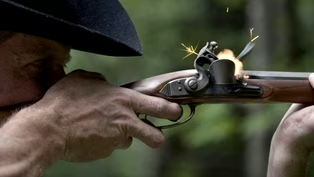 Now Playing
Preview: The Whiskey Rebellion
Video has Closed Captions
The tale of the Whiskey Rebellion (1791-1794), the first major test of U.S. democracy. (2m 30s)
Providing Support for PBS.org
Learn Moreabout PBS online sponsorship









Support for PBS provided by:
The Whiskey Rebellion is a local public television program presented by WPSU