
New Bern Fire-Rescue & Buchanan’s Store
5/21/2026 | 26m 46sVideo has Closed Captions
The New Bern Firemen’s Museum and Buchanan’s Store, a 150-year-old shop near Kerr Lake.
Explore two North Carolina institutions still going strong after 150 years: New Bern Fire-Rescue and Buchanan’s Store. At New Bern Firemen’s Museum, learn how the historic fire service was shaped by rivalries, the Great Fire of 1922 and Hurricane Florence. Then, enjoy a visit to Buchanan’s Store, a community hub since 1878 and a one-stop shop for generations of locals and visitors to Kerr Lake.
Problems playing video? | Closed Captioning Feedback
Problems playing video? | Closed Captioning Feedback
Best of Our State is a local public television program presented by PBS NC
New Bern Fire-Rescue & Buchanan’s Store
5/21/2026 | 26m 46sVideo has Closed Captions
Explore two North Carolina institutions still going strong after 150 years: New Bern Fire-Rescue and Buchanan’s Store. At New Bern Firemen’s Museum, learn how the historic fire service was shaped by rivalries, the Great Fire of 1922 and Hurricane Florence. Then, enjoy a visit to Buchanan’s Store, a community hub since 1878 and a one-stop shop for generations of locals and visitors to Kerr Lake.
Problems playing video? | Closed Captioning Feedback
How to Watch Best of Our State
Best of Our State is available to stream on pbs.org and the free PBS App, available on iPhone, Apple TV, Android TV, Android smartphones, Amazon Fire TV, Amazon Fire Tablet, Roku, Samsung Smart TV, LG TV, and Vizio.
Providing Support for PBS.org
Learn Moreabout PBS online sponsorship- [Announcer] This program is made possible in part by generous support from Dogwood Health Trust, a private foundation based in Asheville, North Carolina, focused on dramatically improving the health and wellbeing of all people and communities in the 18 counties and the Qualla Boundary of Western North Carolina.
[soft music] - [Elizabeth] Coming up on "Best of our State.
From hand-pulled engines to modern heroes, the legacy of those who answered the call and the flames that changed an Eastern North Carolina city forever, then step inside a place where time slows down.
For nearly 150 years, it has been more than a store, it's the heart of the Kerr Lake community.
[soft music continues] We dip into the treasured stories for a look at all the beauty and character of North Carolina.
Hello, I'm Elizabeth Hudson, editor in chief of "Our State Magazine" and your host.
[soft music] From hand-pulled engines in the 1800s to powerful storms in modern times, New Bern Firefighters have always answered the call.
For nearly 200 years, they've stood ready to protect their community, serving with courage, commitment, and heart.
[soft music continues] - [John] The New Bern Fire Department is a huge part of the city of New Bern.
- The fire department here is very cherished.
Were you guys aware that New Bern was the first chartered fire department?
We have a lot of respect from the community in a small amount of weight that we carry.
- The legacy plays a role in everything that we do, 'cause we want to maintain that standard.
We don't want to fall behind in any way, shape, form, or fashion.
- [Jim] What's important about New Bern Fire Department's Museum is it brings that history back.
- [John] This is where it started.
These are the people who really put the work into getting to where we are today.
- What it was like in the past, and how this organization has grown for the future.
- Common theme was safety of the citizens.
- [Firefighter] Bring the rest and then come back.
- [Carol] I love New Bern, and it is my mission to make sure this story is told.
[soft dramatic music] - Welcome to the New Berne Fireman's Museum.
It's dedicated to the firefighters that started the fire service in New Bern around 1845.
When somebody comes in for a tour of the museum, I want them to know how important this equipment was and is to the city of New Bern.
This is where we started.
One of the things that really makes New Bern stand out is we were the first chartered fire department in the state of North Carolina.
The Atlantic Company got their state charter in 1845.
New Bern needed a substantial fire department in the early days, because New Bern was one of the largest manufacturers of lumber in the South at one time.
Of course, New Bern was the first capital of North Carolina, so they also had the means to kind of get things moving.
One of the most unique parts in the very beginning were the two companies that were involved, the Button Company and the Atlantic Company, they both stemmed from the Civil War, The Atlantic Company, the original fire company in New Bern, they left to go fight the Civil War for the South.
End of the Civil War, the Atlantics come home and find the Union Army with a new steam engine at their fire station.
As you can see the plaque here, New Berne Steam Fire Engine Company, that was the official name of what we call the Button Company.
The rivalry started there from the Civil War.
The animosity between the North and the South trying to do the same job.
The other part is, at that time, an insurance company would pay to put a fire out for a homeowner.
Whoever got there first was the one to put it out, so that added fuel to the fire.
The steamers and the hose wagons were pulled to the fire by horses.
This is a replica of Fred.
Fred was one of the fire horses that pulled a hose wagon.
This is the Atlantic's hose wagon.
The driver was John Taylor.
John Taylor was an African American gentleman who was employed by the city as a garbage collector.
John was not a member of the fire department.
During this time, there were, in fact, four different African American fire companies around the outside edges of New Bern.
- It was segregated with all things during Jim Crow.
They had to have a separate place, they had separate equipment.
They even asked for equipment at one point and for a caliber of status.
They were denied that.
- They did last up until about 1912, 1913, but they just did not have the means to keep the company moving.
And it's a shame, because I think the city actually missed out on a lot of very good people that could have contributed a ton more, and probably really wanted to.
[soft bright music] This is the first motorized piece of equipment that the city of New Bern bought.
This is a 1914 American LaFrance.
This is a 750-gallon-a-minute pumper, the big improvement over the steam engines, which were only 500 gallons a minute.
The other one that we do have is the first ladder truck that we bought.
All of these ladders are wooden.
These are the original ladders for the truck.
The ladder truck was purchased in 1927.
This station was opened in 1928 to accommodate both of companies, Atlantic and the Button, hoping to bring some cohesion between the two groups.
The uniqueness of this building is the way it was constructed and the purpose.
One pole goes to the Button room upstairs.
This pole goes to the Atlantic Company room on the other side.
Basically, it's a mirror image of each other when you get upstairs, two meeting rooms, two bathrooms.
This would've been one of the bunk rooms.
It's now been turned into our trophy room.
These are some of the trophies that were earned at competitions in the late 1800s, early 1900s.
The competitions between firefighters, and especially with the Button and Atlantic Company, was the skillset that they had to have as a firefighter.
As you can see on the entry board, you've got New Bern No.
1, which is the Button Company, and Atlantic side by side from the same town competing in Charlotte, North Carolina.
They just did it as a competition to see who was better at it, and it still happens today all across the United States.
- So next thing we're gonna talk about, we find our victims.
Back in the day, it was all about who could do something better than the other.
Once again, he's lifting with his legs and he's dragging the victim up.
How fast they could lay hose, how fast they can hook up the hydrant.
All right, so we're gonna conduct some live fire training this morning here.
Once again- - I think that was today's equivalent to a requirement for training standards, to get out the door in a specific amount of time to arrive on scene within a short amount of time and to be able to, start to finish, mitigate that incident.
- The goal is to establish water supply, hit the benchmark.
Back then, it was time-based between two companies.
Today, our challenge is to make sure our firefighters are on scene, fighting the fire in a timely manner.
- [Radio] Fire in the hole.
- [Firefighter] Copy, fire in the hole.
[siren wailing] - You know, we do have a high standard.
We are constantly training.
[radio transmitting orders] We all work together to accomplish the same goal, and we take pride in our work.
Grab the rest and then come back.
We gotta get them all back.
- [Firefighter] Found one victim!
- [Firefighter] Copy, one victim found, division two.
- And I think that also helps us to also walk around with our head held high.
- [Firefighter] That's good, we'll reset.
[soft piano music] - One of the defining moments with the City of New Bern Fire Department was the Great Fire of 1922.
- It was a very, very cold, windy Friday morning.
Everybody was excited.
The New Bern High football team was loading on the trains on their way to Raleigh.
New Bern High was gonna participate in the state football championship.
- Train left about 7:30 that morning.
Well, a lot of the people that were on that train were members of the fire department.
This is Rowland Lumber Company.
This was the origin of the fire.
The wind was blowing in off of the river, which pushed the fire inland.
Over here on the other side of town, about 10:30 in the morning, a lady was heating water to wash her clothes, - A ember went up the wood stove and landed on top of the house, and that was it.
Street after street, house after house was consumed by the fire.
- The fire department didn't have enough personnel to fight the fire at Rowland, much less let some of them go to the other fire.
So all these orange dots you see here were houses that were destroyed.
About 1,000 homes were burned.
3,200 people lost their place to live and most of the residences were owned by African Americans.
Probably 20 blocks of residential and commercial structures were lost.
- It was devastating because of Jim Crow and segregation.
Blacks weren't allowed in the hospital and they didn't have any place to go.
Even right here at St.
Cyprian church was used as a refuge, a haven, a place for them to go, but eventually there was a tent city that was provided from Fort Bragg, North Carolina.
- One of the other tragedies, a lot of these people, it was a twofold situation.
They not only lost their house, they also lost their job at the lumber mill because the lumber mill burned.
- Although it was a horrible thing, out of that fire, hope did come.
By 1938, there was a hospital built for Blacks in New Bern.
In addition, within one year, a group of sisters built a hotel for Blacks, and it is listed in Victor Hugo Green's "Green Book."
[wistful music] That's a part of history.
You can't tell one story without including the other.
- As big of a tragedy as the Great Fire of 1922 was, we're lucky we only had one loss of life.
- You know, you look at a situation like that, you know, to have something of that magnitude, that large scale, ultimately, you come back and you critique that, and say, how do we improve?
We never wanna see anything to that level again, so that's why we're always trying to improve how we provide a service.
[wistful music continues] - In my opinion, The beginning of the end of this big rivalry between the volunteers, the Atlantic and Button Company, was when the city started hiring more paid personnel, and with the construction of the new main fire station just up the road, we were all called New Bern Fire Rescue.
- I think a strong firehouse culture today is a firehouse that is a family.
I'm doing good, you doing good?
Good to see you.
Today, you see men and women coming from all walks of life.
- As a child, I never imagined myself as a firefighter.
I was offered an opportunity to go to an academy.
I did that, and ever since then, I've never looked back.
- It's really about coming together as one team.
- We're brothers and sisters.
[chuckles] Good morning, everybody.
- [Jim] New Bern Fire Department is still leading the charge in North Carolina - Okay, what grade are you in?
- 10.
- 10th?
- Senior.
- Senior.
- [Firefighter] It's an important job, because it's not just fire, it's about EMS prevention and everything that comes with it, so.
- I am very proud of the New Bern Fire Department.
I honestly am.
As we come through the years, we have grown into what we should be.
- Has anybody ever considered being a firefighter?
Being able to get out in the community and talking with the kids at the high school was such a rewarding experience.
We have three different shifts.
We have an A shift, a B shift, and a C shift, and we have three different stations.
And I just feel like being a member with the fire department just makes me special.
Do you guys have any other questions?
- When I think about the firefighters, who's gonna come next, we wanna leave them in a way that they're well prepared, that we maintain that legacy and that we're moving forward.
Grab the victim and maintain the profile low.
- [John] And I think that loyalty to the department, that dedication to the citizens, it's always been here.
- Good boy, Barnaby.
- [John] Not everybody can do it, but the guys and girls in this department show every day why they're, in my opinion, one of the best around.
[alarm beeping] [dramatic music] [radio transmitting orders] [bright guitar music] - A slogan above the doors says it all, "If we ain't got it, you don't need it."
For generations, one of the oldest general stores on the east coast has welcomed locals and travelers alike to Kerr Lake.
Locals know every creek and corner, and visitors who wander in always find something they didn't know they were missing.
[soft guitar music] [truck whooshing] - Buchanan Store is an icon from the past.
[chimes ringing softly] It still remains that home, warmth, comfort of an old-school country store.
[soft guitar music continues] People know, well, I came there as a child and I'm bringing my grandchild, and I recognize it.
It looks just like it did then.
- [Customer] The ones that's been coming here 40 and 50 years, that's what they wanna see.
They don't wanna see fresh-painted brick and mortars, They wanna see the old Buchanan Store that the floors still shake when you walk in.
- It's like stepping into history.
I don't know of any other store where you can go to and it still has the original items.
You can get the hoop cheese and you can get the little short sodas, and you can sit on the porch and visit - Old country stores like these are a dying breed, and I'm so glad to still see this place prospering, 'cause it it really is a great place, great people.
They're always friendly when you come in.
- [Customer] It's just so special to all of us.
It's historical, and I feel like it's a throwback to another time and place that a lot of people don't get to experience.
- [Lucy] It's something warm and comforting.
I like being able to just sit down and relax and not worry about what's going on in the rest of the world, but just enjoy being at Buchanan Store.
[soft guitar music continues] [crow calling] [bright guitar music] - When I was younger, folks walked up here every day.
It was a farm store.
You met here to go to the fields and work.
I'm James Reese, I bought the store about 11 years ago.
I grew up here locally.
I worked in here as a kid when I was eight, nine years old with my grandmother.
I was over here helping her during the summer when I was out of school, pumping gas and towing ice.
So that's probably my fondest memory.
I learned a lot at a young age, you know, stocking shelves and filling drink boxes.
It used to be a bunch of drink boxes in here.
It's a whole lot more work than I saw as a kid.
You know, alls I saw was how them doors never stopped moving, but now, it's more behind the scenes that you realize, you know, getting the stuff in here, [car whooshing] [bright guitar music continues] keeping the tax man paid, you know.
[laughs] - Have everything on it.
- I think it's a gathering place for the lake people to come together and for the community.
[shoppers chattering softly] My given name is Lucy Brown Buchanan Hawthorne Currin, but most of my buddies and friends and everybody around here will just refer to me as Cookie.
I have been going in the store since I could walk or my parents would carry me in the store, so, you know, it's just like a home away from home.
[bright guitar music continues] Buchanan Store opened April the 13th, 1878, and we believe it is the oldest continuous running family-owned general store in the Southeast United States.
[soft music] The Buchanans first came here about 1847.
It first started with my granddaddy's, Robert Lee Buchanan's two brothers, his two older brothers.
And I think they saw a need and an opportunity, that it would be beneficial to the family and also beneficial to the community.
There were no big grocery stores to go to, and a lot of people didn't have transportation to get to the grocery store, so that's where you got your sugar and your flour and all those kinds of things, and it was a gathering place.
It was a community, a friendly place where you'd always feel welcome and be able to sit down with your friends and discuss tobacco prices, and discuss the weather, and pitch pennies.
[soft music continues] This is actually the ledger from the original first day that it opened in April of 1878.
So you can get a half a pound of coffee for 6 cents, compare that to today's prices, and a half gallon of molasses for 20 cents.
A pair of shoes would be for a dollar, and a pair of pants, a dollar and a half.
Everything that anybody needed in the neighborhood, they could find that at the store.
[soft music continues] It's kinda the center of the family life, kinda like a church would be.
The church and the old fashioned general store would certainly be places that the family would feel safe and enjoy being.
Wilson Fleming is an icon of this world, this community, this store.
He ran the store for about 44 years.
He and his family have also been working the land on this farm for years.
- He was like a second granddad to me, he was awesome.
He was a community man, you know?
He worked half the community on his farm.
Folks still come in here and say, "This is Will Fleming's store," Mr.
Fleming, and that's fine with me, you know?
It'll always be his store in a lot of people's eyes.
[flatware clinking] [bright music] - My dad tried to stock everything that anyone asked for, and if he didn't have it, he'd make sure that he got it for you.
Came up with that slogan, "If we ain't got it, you don't need it."
[birds singing] - After Wilson had to give it up, there was a a period there that we were on the lookout, we were kind of struggling, trying to kind of figure out how it's gonna continue, and I think Jamie, thank goodness, said yeah, this would, like, be a dream of his, too, that he wanted to come back into the store.
- Yeah, is that it for you today?
And I went over there and we made an agreement one Sunday evening, and I went home and told my wife that "I bought you a walk-in pantry."
[laughs] [soft music continues] When I first started it during the winter months, I was lucky to see three people, and two of 'em were the same.
Once they found out I got it, though, and I was being local, and I knew most of them, I started finally getting them back in here and getting it back up in shape.
My wife helped out a lot with that.
She saw a bigger vision of how to make it profitable better than I did.
And then once we got a little flat top back here, little four-eye stove, and started frying the bologna, and then it just blew up from there.
[bright music] [food sizzling] The locals, I think, quit eating at home when I put a grill in, which has helped.
That's kept us alive, really.
Sam?
- Sam.
- Sam?
[food sizzling] [bright music continues] - Jamie and Jennie are doing an outstanding job, and I'm thankful in that I am glad that the word is spreading even more out of Warren County and people that come to the lake that are new to the lake, once they come, they'll be coming back, and they'll tell their friends.
- [Customer] Longest java line.
- It's to the point of my kids when they bring their friends here, and when we have friends that are heading down 85, they'll stop, like, that have no connection to the store whatsoever just 'cause we've talked about it so much and they want to see what Buchanan Store is.
And it's odd, I mean, it's a store.
You know, it's an old country store, but it's just so special to all of us.
[bright music continues] - I've been literally coming to this store all my life.
Yes, sir.
You know, you always have [scanner beeping] things in your childhood you never forget, and being 66, I still enjoy coming to Buchanan, so that hadn't changed.
[Wayne speaking faintly] We come up here several times a year, always come to Buchanan's.
Either coming or going, or why we're here if we need something.
- [Cliff] Who else have you always brought up here?
- My son.
- Who's that?
- You.
[Wayne laughing] You grew up here, too.
Now, I hope it never changes.
I hope it's here until I'm gone, you know?
I hope they don't ever get rid of this place, you know, 'cause it's very special.
There's not many like this left anywhere.
[bright music continues] - I can't imagine not having Buchanan Store.
It's been a part of my life since I was just a child, and I'm so glad that Jamie is running it now and doing a good job, and my children love it and beg to come here.
We spend our summers, practically most of our summers around here, so that's gonna be really important for our family and for the community.
- Yes, it's emotional, it's emotional.
It's just such a happy, satisfied feeling that it is remaining.
[bright music continues] It's worked for almost 150 years, so let's let it work some more.
[birds singing faintly] [bright music] - On those sweltering North Carolina summer days, my grandmother and I kept lunch simple, tomato sandwiches and vinegar-soaked cucumbers.
She tied a thin scarf around her hair to fend off the sun and set up the sprinkler so I could play in the yard.
By afternoon, we retreated to the front porch, waiting for my grandfather to return from the golf course.
He'd join us, letting the afternoon breeze cool him off, and after a few minutes, he'd rise from his chair, catch my eye, and give me a wink.
I'd follow him to the kitchen where he'd pull out a half gallon of vanilla from the freezer and scoop perfect rounds of ice cream into two tall glasses.
From the refrigerator, he'd loop two fingers around a couple of glass-bottled Coca-Colas, pop the caps, and pour the fizzy soda over the ice cream, creating a froth that bubbled up to the rim.
I only knew my grandfather in the twilight of his years, but drinking those Coke floats with him, how he had slurped the last drops with a boyish grin, I saw that he had been a child once, too.
The son of a Franklinville postmaster, a kid who'd skipped rocks in the deep river and thrown baseballs with his seven brothers and sisters.
In those moments with my grandfather, I glimpsed his youth.
This time of year, I see families making their way to ice cream shops and the legendary general stores of our state.
They place their orders, then the cones, the sundaes, the milkshakes arrive and melt away the years.
With ice cream in hand, we are all children of summer, forever young.
[soft bright music] [soft bright music continues] [soft bright music continues] [clapperboard clapping] [soft bright music continues] [soft bright music continues] - [Announcer] More information about "Our State Magazine" is available at ourstate.com or 1-800-948-1409.
- [Announcer] This program is made possible in part by generous support from Dogwood Health Trust, a private foundation based in Asheville, North Carolina, focused on dramatically improving the health and wellbeing of all people and communities in the 18 counties and the Qualla Boundary of Western North Carolina.
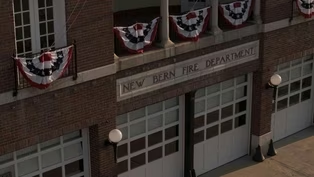
Preview | New Bern Fire-Rescue & Buchanan’s Store
Video has Closed Captions
The New Bern Firemen’s Museum and Buchanan’s Store, a 150-year-old shop near Kerr Lake. (20s)
Providing Support for PBS.org
Learn Moreabout PBS online sponsorship












Support for PBS provided by:
Best of Our State is a local public television program presented by PBS NC