
Oregon Tulip Farm
5/11/2026 | 26m 30sVideo has Closed Captions
Oregon farm raises tulips. Protecting pollinating bees. Man saves and restores old barns.
It’s like a visit to Holland! Discover an Oregon farm growing acres and acres of bright tulips. We’ll take you to Louisiana where scientists are working to solve the mystery of what’s killing America’s bees. Then, harvest season in Florida is all about picking and packing your favorite blueberries. And, saving America’s rural heritage one board at a time. Meet Pennsylvania’s “barn saver.”
Problems playing video? | Closed Captioning Feedback
Problems playing video? | Closed Captioning Feedback
America's Heartland is presented by your local public television station.
Funding for America’s Heartland is provided by US Soy, Sustainable Agriculture Research and Education, Rural Development Partners, and a Specialty Crop Grant from the California Department of Food and Agriculture.
Oregon Tulip Farm
5/11/2026 | 26m 30sVideo has Closed Captions
It’s like a visit to Holland! Discover an Oregon farm growing acres and acres of bright tulips. We’ll take you to Louisiana where scientists are working to solve the mystery of what’s killing America’s bees. Then, harvest season in Florida is all about picking and packing your favorite blueberries. And, saving America’s rural heritage one board at a time. Meet Pennsylvania’s “barn saver.”
Problems playing video? | Closed Captioning Feedback
How to Watch America's Heartland
America's Heartland is available to stream on pbs.org and the free PBS App, available on iPhone, Apple TV, Android TV, Android smartphones, Amazon Fire TV, Amazon Fire Tablet, Roku, Samsung Smart TV, LG TV, and Vizio.
Providing Support for PBS.org
Learn Moreabout PBS online sponsorship>> Hi, I'm Sarah Gardner.
We're mixing together a bit of harvesting and history on this edition of America's Heartland.
Plus, we'll meet a farm family that found a future in flowers.
There are bright and bold tulips as far as the eye can see on these Oregon acres.
All part of a plan to cultivate a future for the family farm.
Bright blue is the color of success for this farm in Florida.
Harvest season is all about picking and packing blueberries that make their way to your supermarket.
We'll take you to Louisiana where scientists are working to save America's Honeybee population.
And travel back in time with a man known as the "Barn Saver".
It's all about keeping rural history alive one board at a time.
It's all coming up on America's Heartland.
>> America's Heartland is made possible by: >> America never stops.
Neither do the farmers and ranchers who call her home.
And as rural America grows further, Farm Credit will be there, just as we have for 100 years.
>> CropLife America, representing the companies whose modern farming innovations help America's farmers provide nutritious food for communities around the globe.
>> The Fund for Agriculture Education.
A fund created by KVIE to support America's Heartland programming.
Contributors include the following: ♪ You can see it in the eyes of every woman and man.
♪ ♪ In America's Heartland, living close to the land.
♪ ♪ There's a love for the country and a pride in the brand.
♪ ♪ In America's Heartland, living close, ♪ ♪ close to the land >> Hi.
Thanks for joining us on America's Heartland.
We're always glad we can share some very special stories with you.
Let's start in the Sunshine State.
Florida farmers produce a significant portion of the fruits and vegetables that make their way to your supermarket.
Everything from oranges and grapefruit to lettuce, tomatoes, even Brussels Sprouts.
And come spring, Florida farmers are harvesting some special produce, even as the snow flies up north.
It's all about a colorful crop of blueberries.
♪♪ >> In two days they'll be in New York and in three days they'll be on the store shelf somewhere.
>> The blueberries are on the move this morning at the William G Roe and Sons Packing House not far from Orlando.
And they'll keep moving through a short six week blueberry season in Florida where the Roe family will pack more than a million and a half pounds of these tiny bundles of dark-blue sweetness.
>> At this pace it is hard to tell who is keeping up with whom.
The computerized machines or the workers.
>> As soon as they packed they'll go into the cooler and be put in front of a 35,000 CFM fan.
It cools them down in about 45 minutes to room temperature and they're ready to go out the door.
>> If that customer out there ever gets their package of blueberries and they say, 'hey that feels little light', you can say, 'no no hold on now.
>> We're trying to get within three grams of the exact legal requirement for each one of these sized clam shells.
This machine can do up to 180 cups a minute.
We slow it down a little bit to keep it more accurate.
And they are tracked back to the grower by bar code and a little sticker on the carton.
So traceability right back to the field on the day it was harvested is very efficient.
>> Bill Roe is the Vice President of Operations for Roe and Sons.
He's the third generation to manage this operation.
William G. Roe started the business in 1927 packing citrus.
>> My grandfather originally came from upstate NY back in the early 20s.
Came down here and started picking fruit.
Got into the citrus business and eventually had a packing house.
>> It's safe to say growing blueberries was not on William G. Roe's original business plan.
But just like their grandfather, the present generation of Roes has had to innovate and explore new business opportunities.
Like blueberries.
>> So we went out, we bought a field.
We bought the equipment.
We converted our packing house over and boom, the blueberry industry just kind of blew up around us as we were growing up with it.
>> Now, five dozen growers from around the region and the Roes grow blueberries to be packaged under several different labels.
The Roes grow 18 acres themselves.
When you think blueberries, Florida isn't the first state that comes to mind.
But it turns out that the growing season here is perfectly timed.
>> The blueberry industry now is a year-round industry.
The northern hemisphere blueberry market starts in Florida.
And it's about six to eight week season.
So we're in a very narrow little patch when there really are no other blueberries in the world that are coming in.
♪♪ >> Another not-so-typical product sold by the Roes: tangerine juice.
Slightly sweeter than orange juice, the juice is sold under the "Noble" brand.
>> As with many farmers today, the Roes have a greater focus on environmental concerns.
In their case, bottling their juices in containers made from corn based plastics instead of petroleum.
>> Which means they're completely compostable.
Put them in an active compost pile.
In sixty days they are gone.
>> The Roe's are proud to carry on the legacy they inherited from their grandfather.
Several Roes serve in the management and daily operations of the business.
The latest is Bill's daughter, April.
She left her job as an Atlanta investment banker to join the team.
>> When I started from day one I knew that they trusted me and I trusted them.
And that takes a long time to develop working for another employer.
>> A family farming tradition getting sweeter with each generation.
>> You can call them "Blue" berries, but they are the "golden" child in the galaxy of Fruits and vegetables.
Blueberry consumption in the U.S.
has more than doubled in the past 15 years, thanks to the health benefits of this sweet and tasty fruit.
Blueberries are low in calories, but high in anti-oxidants, vitamins, minerals and dietary fiber.
And flavor aside, some folks still use the natural dye in blueberries to color textiles.
>> Honeybees are critical for pollinating much of the produce that we enjoy every day.
We've told you in the past about national efforts to improve native habitats for our bee populations.
But recent studies have shown that honeybee populations continue to be under attack from a variety of fronts including something called Colony Collapse Disorder.
There may be a single, or multiple causes for the die-off in bee populations, but scientists says the increasing incidence demands answers now.
Our Rob Stewart looks at one research program in Louisiana where scientists are attempting to isolate specific causes.
♪♪ >>Honeybees may be small in size, but the loss of bee colonies worldwide is a huge concern for agriculture.
Bees pollinate some 30% of the food crops that we enjoy every day.
But in recent years, both a predator called the Verroa mite and something called "Colony Collapse Disorder" have been decimating hives and killing off bees.
>> It's an enormous problem and it is a result of several things coming together all at the same time.
>> Dr.
Tom Rinderer directs research for the U.S.
Department of Agriculture's Honeybee Breeding, Genetics and Physiology laboratory in Baton Rouge Louisiana.
>> We've got new pests and pathogens, the parasitic mites have been with us for too short a time for any solution other than the ones we've provided to be available so we're in the leading edge of that.
We do have stocks, bee stocks, that are resistant to Verroa mites.
>> Those bees, bred with what's called Verroa Sensitive Hygiene, or VSH, can interrupt the process of mites attacking the hive.
>> So these are bees in a VSH colony that are basically searching and destroying mite infested pupae.
>>Baby bees.
>> Baby bees.
There are several parts to the trait.
First bees have to detect a problem.
In this case we see a bee who's chewing open a capped cell where there's a pupa.
There you see the hole in the cell cap.
So they're uncapping the cell.
>> That bee knew that something was wrong in there.
>> Yes.
Different shot here.
These bees are now removing the injured pupa and you can see the pupa is destroyed and there's another one being pulled out and as you can see, it's infested with Verroa mites.
>> There's the Verroa mite.
>> There's the mite.
So these bees have minimally disrupted the reproduction of this mite where it's occurring on this pupa.
>> Outside the lab, these hives contain 60 thousand bees used in a nationwide field test.
Bees that have been bred with the VSH trait.
>> These three colonies did the best.
We use them as breeding material.
These colonies last year went to seven different places and pollinated four different crops >> Healthy bees insure plentiful crops, affecting prices for many fruits and vegetables at the supermarket.
The new breed of bees here will go to commercial beekeepers across the nation.
>> Basically just breaking this down.
This is in action, what is really helping to repair some of the major problems we're seeing with bees.
>> We think this could be very useful, yes.
You know, any of these breeding programs to increase the natural genetic-based resistance in these bee populations can't help but be useful.
>> Researchers here say the impact on agriculture is huge.
One study from Cornell University put the value of pollination at 15 billion dollars a year.
>> There is a lot of industry support for it.
I think that they see that we are doing it and that we are moving forward, and I think they are very very excited about that.
>> As research continues on colony collapse, the lab has also developed improved honey bee strains using varieties from eastern Europe.
>> We discovered that here at this laboratory.
It was a 14 year project from the first trip to Russia to now where we have this association that's dedicated to earning their living producing and selling Russian bees and also to maintaining and improving that stock.
>> This is great biology.
Without bee pollination, we could not possibly have the food production that we have, the agricultural systems that we have, so it's a small industry, but it's key to the agriculture that we have and that we see today.
>> Honeybees are not native to the U.S.
European in origin; they were brought to America by early settlers.
In addition to tasting good, honey has antibacterial and antioxidant properties as well as a wide array of vitamins including Vitamin B, riboflavin and niacin.
♪♪ >> Hi I'm Paul Robins and here's something you may not have known about agriculture.
Every time I talk about onions, it brings a tear to my eye.
Oh, it has nothing to do with emotions, it's all chemistry, but more on that later.
Eat them on hamburgers, hot dogs, in soups, stews, you name it, onions are a tasty addition to any meal and they have been since the dawn of time.
When early man first walked the earth, he was probably toting onions to add to his meal of sabre toothed tiger.
Some historians claim that onions were the first vegetable to make it to the dinner table.
And whether they were harvested wild or cultivated, cultures around the world dined on onions thousands of years ago.
Onions were highly thought of by the ancient Egyptians who believed the onion's spherical shape and concentric rings symbolized eternal life.
Roman gladiators were rubbed down with onions to firm up their muscles.
Fast forward to 1492 and our old friend, Christopher Columbus brought varieties of cultivated onions here to the New World.
Throughout history many cultures have used onions for medicinal purposes believing them to have anti-inflammatory and antioxidant properties.
But let's get back to my tears.
Why do some folks cry when they slice an onion?
Well, slicing breaks down cells in the onion walls releasing chemicals into the air that aggravate your eyeballs.
Some folks claim that chilling inhibits the enzymes from activating.
And if you want another trick?
Use a fan to blow the gas away from your face when you slice.
>> Let's take a little trip back in time.
Both to revisit one of our favorite stories and also meet a man whose future is tied to saving things from the past.
Travel through the Heartland and you're sure to come across imposing historic barns that dot America's rural landscape.
Age and the elements take their toll on structures like these, but one man in Pennsylvania decided that his skills could help preserve the past.
♪♪ >> It's just a great feeling to know that I'm saving a part of this history that so many people think is garbage.
I'm saving 80 to 95 percent of each building that would otherwise have been landfill or rotting away because people can't afford to maintain them.
>> John High has made it his mission to save as many old Pennsylvania barns as he can.
He calls his Lancaster County business, "The Barn Saver".
>> John's rescued more than 200 historic structures, either restoring them to their old luster or, in most cases, recycling the boards and beams into something new, like a house.
For High, saving barns or at least, parts of them, is a kind of penance >> Well, I was working for an excavating company and my boss would say, get rid of them because we are putting a development in.
That meant the house, the barn, everything was just bulldozed and sent to the landfill and I would look through these buildings before we were to start them and I'd just shake my head and cry.
>> After leaving his excavating job in the late 90's.
John discovered his woodworking skills could be used to save barns, doing virtually all of the work by hand.
>>It's a little bit of a delicate process.
But we actually draw a blueprint of every beam of the barn and then we put a tag on it, so that every beam has a tag on it, so they know how to put it back together at the other end.
>> This barn that High is working on is more than a century old.
Owner Greg Snell's grandparents bought it along with the family farm in 1940.
>> Well as we've been taking it down I've been thinking of all the times my mother was telling me she was in charge of being up in the hay mounds when she was a little girl, stomping the hat down when they threw it up and all.
>> Snell says the farm was sold in the 1970's after his grandparents died.
With the property being converted to a new development, Greg Snell asked the "barn saver" to salvage the pieces for posterity.
>> Well it's going to be converted into a home and it will have two lofts in the upper, um, where the hay mounds were and it will have a living area down below.
>> Brad Smith has been enjoying his converted barn for about two years.
He said he looked quite a while for just the right one to resurrect.
>> Above all I wanted to find one that was pretty pristine.
Most barns that you find that you take down have something wrong with them.
You know there's the age.
There's going to be something, some sort of problem.
Some are worse than others.
This was in really good shape.
>> Smith says there's a real charm in living in a home that's built this way.
>> The idea was to get the grand feel.
This is how it was set up originally.
The hay wagon would pull right in here and they would fill the barn with hay on either side.
>> Smith says it's a challenge to take an unheated, aging structure and turn it into a house, with modern conveniences.
Brad calls it the perfect marriage of old and new.
But John High worked his magic once again.
>> Some of the magic John makes with old barns has been immortalized in an illustrated children's book, written by High's author-wife, Linda.
>> Papa saves barns from bulldozers.
I there a lot to save, I ask.
Papa nods and I smile.
>> And that same satisfaction is something High feels every day about his chosen vocation.
>> It's very gratifying to know that I'm saving a piece of American history.
I feel sorry for people who go to work and hate their job.
I wake up in the morning I'm ready to work to save another piece of our history and just keep this thing rolling.
>> History is big in Pennsylvania.
In addition to centennial and bi-centennial farms, the Keystone state was home to the first Presidential mansion in the United States, some of the first newspapers in the new republic and the world's first oil well.
And while most folks associate Daniel Boone with Kentucky, The celebrated woodsman was born just outside Reading, Pennsylvania.
>> For most of us, flowers are just something that brighten up the yard or help decorate for a special occasion.
But horticulture in all of its forms, from nursery plants, to landscaping, even garden equipment, is a multi-billion dollar industry in the United States.
And for some farm families, it's a way to use their land to attract visitors.
Visitors that bring in needed income.
Our Jason Shoultz found one family in Oregon welcoming tourists who tiptoe through the tulips.
>> It's early morning in Oregon's Willamette Valley and the irony of Ross Iverson's first morning chore of the day isn't lost on him.
>> Driving his diesel powered tractor past sedans and minivans, delivering wood to be burned in a steam engine.
On a tractor that he's never used on his farm.
But such is the life of a modern-day farmer-slash-tour guide >> You have to broaden it out.
you just don't make it on the farm crops.
That's just about the situation now.
>> It'll take a couple of hours for the boiler to heat up enough to power the tractor.
In the meantime people start arriving to take in the tulips in this beautiful valley.
♪♪ >> There are 50 acres of tulips planted here at The Wooden Shoe Tulip Farm.
That's more than 10 million reds, yellows, oranges and whites.
A photographer's dream.
And an escape for folks from more urban areas who otherwise wouldn't have an opportunity to experience farm life.
>> We kind of joke sometimes that we are really not in the flower business but in the business of creating experiences for people.
>> Barb Iverson is Ross Iverson's daughter and the President of the Wooden Shoe Tulip Farm.
It's a family operation with her sister in law in the gift shop.
Her brother carving up wooden shoes and her nephew helping out with farm operations.
>> Each year from late March to early May the farm opens its doors to visitors.
For a few bucks per carload people can wander the fields, grab some grub, or pick up a tulip trinket to take home from the gift shop.
>> The farm also is a popular destination for school field trips.
>> I think one of the things here is they come out we've got tractors, old steam tractors.
But I think one of the best things here is they can just come out and walk through the field.
There are many places where you can just go out and walk through a farmer's field.
And when you get out in the middle of a field, I don't care if it is a grass seed field or a potato field, whatever it is.
When you are out in the middle of a field that is an experience in itself.
And I think there is a lost connection with that urban population.
>> And Barb Iverson understands the attraction to this place.
She's an amateur photographer herself.
♪shutter sounds >> More and more farms and ranches across the US are opening their doors to visitors, this type of thing even has a name.
It's called "agritourism".
Although visitors don't explore the other working parts of this 2000 acre farm where they grow grass, wheat, and vegetables.
They do get to spend some time with Ross who started this farm back in 1950.
He's officially retired but you'll find him working over here pretty much every day.
>> I was running the trolley the other day and the man sitting next to me said do you need help with your money?
Look at all the money you are making here.
I said you know if I was running it you wouldn't be here.
I wouldn't let anyone on the place.
I'd pick all the flowers.
I wouldn't leave any for you to look at.
He kind of looked at me didn't know what to say.
>> Don't believe him.
Don't believe him.
He enjoys it.
>> Whatever he says, he enjoys it.
He wanders through and he always talks to people.
We have the tram ride in the field.
He jumps on that, and he'll drive back and forth just to visit people.
He really enjoys it.
>> After growing tulips for sale on the bulb market for several years in 1985 they decided to open their doors to the public.
They'll get upwards of 200,000 people visiting on a good year.
>> We had some neighbors that said oh you really need to open your field in the spring.
It's just gorgeous.
You should invite the public out and do it.
We would always poo poo them say no that's a lot of work.
And so one year Easter was going to fall right perfect were gonna be in full bloom.
And we thought, “you know, why dont we?” So we opened the tulip field and we had a traffic jam.
>> Really the agritourism is well worth it.
It's a lot of work though.
Youve got the liability, Youve got people everywhere all the time, Then again there is the rewards too.
>> And after a few hours, the steam powered tractor is ready for its turn in giving that farm experience.
>> This is a 1915 Russell.
Made in Massillon, Ohio.
>> Can you show me how to drive one of these things?
>> I sure can.
Do you have a learners permit?
Ha.
>> You don't tiptoe through the tulips with this baby.
The Iverson's neighbor Roy Thompson knows that visitors here aren't getting a complete taste of the ups and downs of farm life, but he says sharing a small slice is definitely worth it.
>> They don't see the rainy days and all that stuff.
But it's yeah.
To get out of those enclosures.
Pavement.
Get out into the dirt.
So we are out here just to give them something else to look at.
>> Yeah you can grow a great crop.
But there is also another reward that you get in farming, and theres a satisfaction that maybe you have made other people's lives a little bit better.
>> Lots of beautiful flowers.
Before we leave you, why not check out our America's Heartland website at AmericasHeartland.org.
You'll find video from all of our shows and lots more information on agriculture.
And if you're into social media, be sure to find us on Facebook.
You can also access our stories at the America's Heartland channel on YouTube.
That's going to do it for us.
We're glad you came along.
We'll see you next time on America's Heartland.
♪ You can see it in the eyes of every woman and man.
♪ ♪ In America's Heartland, living close to the land.
♪ ♪ There's a love for the country and a pride in the brand.
♪ ♪ In America's Heartland, living close, ♪ ♪ close to the land >> America's Heartland is made possible by: >> America never stops.
Neither do the farmers and ranchers who call her home.
And as rural America grows further, Farm Credit will be there, just as we have for 100 years.
>> CropLife America, representing the companies whose modern farming innovations help America's farmers provide nutritious food for communities around the globe.
>> The Fund for Agriculture Education.
A fund created by KVIE to support America's Heartland programming.
Contributors include the following:
 New
NewVideo has Closed Captions
Harvest season in Florida is all about picking and packing your favorite blueberries. (5m 7s)
 New
NewVideo has Closed Captions
Learn about onions and how to prevent watery eyes while cutting them. (1m 40s)
 New
NewVideo has Closed Captions
We’ll take you to Louisiana where scientists are working to solve the mystery of what’s killing bees (4m 59s)
 New
NewVideo has Closed Captions
It’s like a visit to Holland! Discover an Oregon farm growing acres and acres of bright tulips. (6m 20s)
 New
NewVideo has Closed Captions
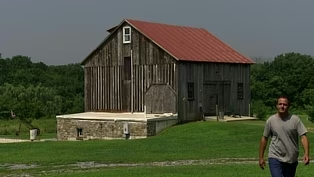
Saving America’s rural heritage one board at a time. Meet Pennsylvania’s “barn saver.” (4m 35s)
Providing Support for PBS.org
Learn Moreabout PBS online sponsorship

- Food
Christopher Kimball’s Milk Street Television
Transform home cooking with the editors of Christopher Kimball’s Milk Street Magazine.









Support for PBS provided by:
America's Heartland is presented by your local public television station.
Funding for America’s Heartland is provided by US Soy, Sustainable Agriculture Research and Education, Rural Development Partners, and a Specialty Crop Grant from the California Department of Food and Agriculture.