
Louisiana Honeybee Research
Clip: 5/11/2026 | 4m 59sVideo has Closed Captions
We’ll take you to Louisiana where scientists are working to solve the mystery of what’s killing bees
We’ll take you to Louisiana where scientists are working to solve the mystery of what’s killing America’s bees.
Problems playing video? | Closed Captioning Feedback
Problems playing video? | Closed Captioning Feedback
America's Heartland is presented by your local public television station.
Funding for America’s Heartland is provided by US Soy, Sustainable Agriculture Research and Education, Rural Development Partners, and a Specialty Crop Grant from the California Department of Food and Agriculture.
Louisiana Honeybee Research
Clip: 5/11/2026 | 4m 59sVideo has Closed Captions
We’ll take you to Louisiana where scientists are working to solve the mystery of what’s killing America’s bees.
Problems playing video? | Closed Captioning Feedback
How to Watch America's Heartland
America's Heartland is available to stream on pbs.org and the free PBS App, available on iPhone, Apple TV, Android TV, Android smartphones, Amazon Fire TV, Amazon Fire Tablet, Roku, Samsung Smart TV, LG TV, and Vizio.
Providing Support for PBS.org
Learn Moreabout PBS online sponsorship>> Honeybees are critical for pollinating much of the produce that we enjoy every day.
We've told you in the past about national efforts to improve native habitats for our bee populations.
But recent studies have shown that honeybee populations continue to be under attack from a variety of fronts including something called Colony Collapse Disorder.
There may be a single, or multiple causes for the die-off in bee populations, but scientists says the increasing incidence demands answers now.
Our Rob Stewart looks at one research program in Louisiana where scientists are attempting to isolate specific causes.
♪♪ >>Honeybees may be small in size, but the loss of bee colonies worldwide is a huge concern for agriculture.
Bees pollinate some 30% of the food crops that we enjoy every day.
But in recent years, both a predator called the Verroa mite and something called "Colony Collapse Disorder" have been decimating hives and killing off bees.
>> It's an enormous problem and it is a result of several things coming together all at the same time.
>> Dr.
Tom Rinderer directs research for the U.S.
Department of Agriculture's Honeybee Breeding, Genetics and Physiology laboratory in Baton Rouge Louisiana.
>> We've got new pests and pathogens, the parasitic mites have been with us for too short a time for any solution other than the ones we've provided to be available so we're in the leading edge of that.
We do have stocks, bee stocks, that are resistant to Verroa mites.
>> Those bees, bred with what's called Verroa Sensitive Hygiene, or VSH, can interrupt the process of mites attacking the hive.
>> So these are bees in a VSH colony that are basically searching and destroying mite infested pupae.
>>Baby bees.
>> Baby bees.
There are several parts to the trait.
First bees have to detect a problem.
In this case we see a bee who's chewing open a capped cell where there's a pupa.
There you see the hole in the cell cap.
So they're uncapping the cell.
>> That bee knew that something was wrong in there.
>> Yes.
Different shot here.
These bees are now removing the injured pupa and you can see the pupa is destroyed and there's another one being pulled out and as you can see, it's infested with Verroa mites.
>> There's the Verroa mite.
>> There's the mite.
So these bees have minimally disrupted the reproduction of this mite where it's occurring on this pupa.
>> Outside the lab, these hives contain 60 thousand bees used in a nationwide field test.
Bees that have been bred with the VSH trait.
>> These three colonies did the best.
We use them as breeding material.
These colonies last year went to seven different places and pollinated four different crops >> Healthy bees insure plentiful crops, affecting prices for many fruits and vegetables at the supermarket.
The new breed of bees here will go to commercial beekeepers across the nation.
>> Basically just breaking this down.
This is in action, what is really helping to repair some of the major problems we're seeing with bees.
>> We think this could be very useful, yes.
You know, any of these breeding programs to increase the natural genetic-based resistance in these bee populations can't help but be useful.
>> Researchers here say the impact on agriculture is huge.
One study from Cornell University put the value of pollination at 15 billion dollars a year.
>> There is a lot of industry support for it.
I think that they see that we are doing it and that we are moving forward, and I think they are very very excited about that.
>> As research continues on colony collapse, the lab has also developed improved honey bee strains using varieties from eastern Europe.
>> We discovered that here at this laboratory.
It was a 14 year project from the first trip to Russia to now where we have this association that's dedicated to earning their living producing and selling Russian bees and also to maintaining and improving that stock.
>> This is great biology.
Without bee pollination, we could not possibly have the food production that we have, the agricultural systems that we have, so it's a small industry, but it's key to the agriculture that we have and that we see today.
>> Honeybees are not native to the U.S.
European in origin; they were brought to America by early settlers.
In addition to tasting good, honey has antibacterial and antioxidant properties as well as a wide array of vitamins including Vitamin B, riboflavin and niacin.
 New
NewVideo has Closed Captions
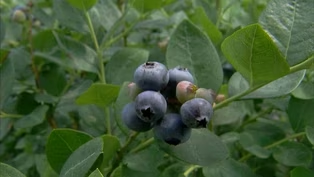
Harvest season in Florida is all about picking and packing your favorite blueberries. (5m 7s)
 New
NewVideo has Closed Captions
Learn about onions and how to prevent watery eyes while cutting them. (1m 40s)
 New
NewVideo has Closed Captions
It’s like a visit to Holland! Discover an Oregon farm growing acres and acres of bright tulips. (6m 20s)
 New
NewVideo has Closed Captions
Saving America’s rural heritage one board at a time. Meet Pennsylvania’s “barn saver.” (4m 35s)
Providing Support for PBS.org
Learn Moreabout PBS online sponsorship

- Food
Christopher Kimball’s Milk Street Television
Transform home cooking with the editors of Christopher Kimball’s Milk Street Magazine.











Support for PBS provided by:
America's Heartland is presented by your local public television station.
Funding for America’s Heartland is provided by US Soy, Sustainable Agriculture Research and Education, Rural Development Partners, and a Specialty Crop Grant from the California Department of Food and Agriculture.