
Baseball: Echoes from the Bleachers
10/22/2026 | 56m 12sVideo has Audio Description
Explore the sport’s most extraordinary stories through the Baseball Hall of Fame’s vaults.
Explore the sport’s most extraordinary stories through the Baseball Hall of Fame’s vaults, opened for the first time. With access to tens of thousands of artifacts and over 10,000 hours of never-before-seen media, the film tells a story bigger than the game: the story of American itself.
See all videos with Audio DescriptionADProblems playing video? | Closed Captioning Feedback
Problems playing video? | Closed Captioning Feedback
Baseball: Echoes from the Bleachers
10/22/2026 | 56m 12sVideo has Audio Description
Explore the sport’s most extraordinary stories through the Baseball Hall of Fame’s vaults, opened for the first time. With access to tens of thousands of artifacts and over 10,000 hours of never-before-seen media, the film tells a story bigger than the game: the story of American itself.
See all videos with Audio DescriptionADProblems playing video? | Closed Captioning Feedback
Where to Watch Baseball: Echoes from the Bleachers
Baseball: Echoes from the Bleachers is available to stream on pbs.org and the PBS app.
Providing Support for PBS.org
Learn Moreabout PBS online sponsorship♪♪ ♪♪ Buhagiar: Cooperstown is one of those places you don't just stumble upon.
It's a pilgrimage for many baseball fans.
Rawitch: Every time you look at baseball, you see America.
And when you look at America, you can see baseball.
♪♪♪ Augustine: This game is so core to our history.
♪♪ Fleer: Baseball has been our national pastime for over 170 years.
♪♪♪ People find great meaning in it, and that really connects them with the stories from the past.
♪♪ Rawitch: The reality is that when you come here, you could spend hours and hours and hours and not see it all, have to come back.
That's the beauty of this place.
We're talking about over 40,000 artifacts and over 3 million documents, over 20,000 books.
Hundreds of thousands of photos and baseball cards.
♪♪ Augustine: We're telling stories of great moments.
Michaels: It's a ground ball to the right side.
Speared by Phillips.
Flips to Eckersley.
Yes!
And the A's are the world champions!
Augustine: We're telling stories of the low points in baseball history.
Goldberg: We were of Jewish religion, but we were American athletes.
Augustine: We're telling big known stories.
Gehrig: Today, I consider myself the luckiest man on the face of the earth.
Augustine: We're also telling unknown stories.
Man: Alright, mystery challenger, will you enter and sign in, please?
Augustine: And that is what makes up this fabric that is baseball history.
Rawitch: Some stories you may have heard before, and others you haven't, but all of them help tell the story of American history through the lens of baseball.
♪♪ The Hall of Fame is an important American institution because it replicates so many of the values that Americans hold dear, whether it's perseverance or integrity or courage, respect, honor.
All these things that we like to think of as key things about being an American, it's also a key thing about baseball.
But, ultimately, what is really important here is that we can tell the stories in their entirety, the good, the bad, the ugly, and that we can do it from a curatorial perspective, from a museum perspective that just tells the truth.
And it really comes down to six words.
It's preserving history... honoring excellence... and connecting generations.
♪♪ Augustine: The 1989 World Series was known as the Battle of the Bay.
It was between the Oakland Athletics and the San Francisco Giants.
Michaels: I'm Al Michaels.
Welcome to Game 3.
It's been dominant Oakland pitching, of course, in the first two games, so Roger Craig has made some changes in the Giants lineup.
Augustine: Fans are filing into the stadium to watch what's hopefully going to be another great game.
Michaels: But there was a key early play involving Terry Kennedy dropping... Augustine: So Dave Stewart, who was the winning pitcher for Game 1 of the World Series, was not scheduled to pitch in Game 3 at all.
He was in the dugout with his teammates.
McCarver: You don't often think of key plays in a 5-1 ballgame, but let's go back to the top, take... Michaels: I'll tell you what.
We're having an earth-- [ Static crackles ] [ Muffled stadium sounds ] Augustine: And the Loma Prieta earthquake hits.
Woman: Major earthquake, an earthquake which was felt from Oakland to Sacramento, as far south as Los Angeles.
[ People screaming ] Vincent: Postponing the game because there is no power in the stadium.
We would like you to leave in an orderly way.
Man: Ladies and gentlemen, your attention, please!
Power has been interrupted... Man: We are in the Marina District of San Francisco.
It looks like part of an entire city block is burning.
Woman: An entire section of the Bay Bridge has been lost.
Augustine: When the word started coming down that the Bay Bridge went down, he got really worried because his sister took the Bay Bridge almost every day to work.
And so Dave Stewart went to his car and he drove back to Oakland, which turned out to be a five-hour drive.
♪♪♪ He was still in his baseball uniform.
He had never changed.
Man: Can only describe the situation here as nightmarish.
There are no traffic lights.
Civilians, if you were, are trying to direct traffic.
People are wandering the streets aimlessly.
It is... Augustine: But after five hours, he got home and he realized that his sister was still safe.
He then stayed around and helped, so he was bringing in supplies, making sure people had food, making sure people had water.
That was his focus, was making sure he was taking care of his family and his community.
Thorne: You are from Oakland.
The earthquake took place.
Of all the players, you've been involved personally as much as anyone.
Stewart: You know, I'm down there late, late evening or early in the morning when the workers are pretty much tired and, um... Augustine: Because Dave Stewart had pitched in game 1, he was not scheduled to pitch in the original Game 3.
However, there was a 10-day break between when it was originally scheduled to when it actually got played, so he went back out there.
He went on the mound.
He dominated.
Michaels: And Mitchell is gone on strikes.
And so Dave Stewart picking right up where he left off a week ago Saturday.
And down he goes on strikes.
Augustine: He won his second World Series game.
Michaels: And the A's are one victory away from their first world championship in 15 years.
Augustine: We have a number of artifacts that document all of the 1989 World Series.
We have programs from each game.
We have score sheets.
We have tickets.
♪♪ But we also have the jersey that Dave Stewart wore for game 3 when he pitched and won his second World Series game.
♪♪♪ One of the coolest things about artifacts is that they can tell a multitude of stories.
So this jersey can talk about his World Series MVP.
We could talk about the Loma Prieta earthquake and how that paused the World Series game.
But we could also talk about different facets of the jersey.
And one of my favorite parts is the elephant on the sleeve.
The elephant has been a part of Athletics folklore for a very long time, since its inception.
In fact, back when the Athletics were founded, it was actually this running joke that John McGraw, manager of the Giants, would tell Connie Mack that this team that he got was a white elephant.
♪♪ And a white elephant back then was known as to be a wonderful gift but also a very expensive gift that you have to upkeep.
The A's then embraced this look of the white elephant, and so it became part of the logo.
Michael: A's trying to sweep, but the Giants have certainly not made life easy for them tonight.
That's a ground ball to the right side.
Speared by Phillips!
Flips to Eckersley!
Yes!
He's there in time!
And the A's are the world champions!
♪♪♪ Man: We're very happy to present this Most Valuable Player trophy to you.
Augustine: This story is so part of baseball history and part of the baseball legend that people tend to forget that baseball players are also human.
Yes, they go out there, they play this game every single day, but they also have families.
They have other interests.
They have people they want to make sure they take care of.
And this moment of Dave Stewart making sure that he gets home to make sure that his sister is safe really speaks to that humanity that I think many other people can relate to, because there were many other people in the Oakland and Bay Area that were also making sure that their family members were safe.
♪♪ ♪♪♪ Buhagiar: For any major league player, their 3,000th hit is going to be incredibly significant.
But Roberto Clemente's 3,000th hit wasn't just a milestone.
it was a moment frozen in time.
♪♪♪ I'm not sure there's ever been really a better person in the game of baseball.
Clemente was as famous for his on-the-field excellence as he was for the help that he provided his community off of the field.
[ Chatter ] Prince: Matlack on the 0-1.
Bobby hits a drive into the gap into left center field!
There she is!
♪♪ ♪♪ Papers flying.
Everybody's standing.
A double for Roberto!
Buhagiar: Roberto Clemente was the first Latin American player to reach the 3,000-hit milestone.
Clemente: I think I can play four more good years because my body is in good shape, and I got a very strong body, and I think that I can adjust myself pretty good in baseball which lots of fellows cannot do it.
Buhagiar: But for Roberto Clemente, his 3,000th hit actually ended up being the final big-league hit of his career.
♪♪ In late December of 1972, an earthquake absolutely ravaged Nicaragua.
Man: The risk of infectious disease is very high in the city center.
There are still hundreds of corpses buried in the rubble of Managua.
Buhagiar: And in an attempt to get supplies to the victims there, Roberto Clemente was on a plane full of those supplies when it crashed off the coast of Puerto Rico.
Man: Pittsburgh Pirates outfielder Roberto Clemente.
Late last night, he was killed when the cargo plane that he was aboard crashed shortly after takeoff from San Juan.
Governor of Puerto Rico has proclaimed three days of mourning for Clemente.
He was a national hero on the island.
Buhagiar: For any player that is up for election to the National Baseball Hall of Fame, they have to wait five years post-retirement in order to be considered.
But for Roberto Clemente, as soon as he passed, the Baseball Writers Association of America, who are the electing organization for the Hall of Fame, they scheduled a special election waiving that five-year waiting period, and Roberto Clemente was almost immediately elected to the Hall of Fame, making him the first Latin American player inducted into the Baseball Hall of Fame, as well.
And we have a number of artifacts in our collection that help to tell the story of Roberto Clemente's 3,000th hit, including the bat that he used for the hit, the cap he was wearing when he got the hit, the official score sheet from Pittsburgh that day, as well as a ticket stub from the game.
♪♪ The cap has an interesting story because Roberto Clemente wouldn't have been wearing a cap during his hit.
He was required to wear a helmet at that point.
And that is true.
But Roberto Clemente notoriously would wear his cap underneath his batting helmet.
The cap actually ended up in the hands of a young fan, who donated it to the Hall of Fame after Clemente's death in early 1973.
History does not always come to Cooperstown right away.
In 1990 is actually when we received a ticket stub from the 3,000th-hit game, so nearly 18 years after the hit occurred.
♪♪ The score sheet shows all of the Pirates hits that day, but the official scorer knew the significance of the 3,000th hit and made sure to note that on the score card right above his signature.
♪♪ Roberto Clemente really is one of those figures that transcends time and baseball.
He is incredibly beloved by baseball fans and by people in his native Puerto Rico.
I'm really not sure there's anyone that exemplifies the American values of building community and helping your neighbor like Roberto Clemente.
♪♪ ♪♪ ♪♪ Fleer: In the immediate aftermath of 9/11, when New York is completely shaken... baseball resumes and an amazing moment happens when Mike Piazza comes to the plate.
[ Crowd cheering ] Man: The events of September 11th will be forever etched in the minds of everyone in this country.
Fleer: After the tragic events of 9/11, Mike Piazza and everyone else are wondering when, if, and how baseball should resume.
Man: Let's face it.
It was a tragedy of enormous proportions, and, in one way or another, everyone across this great land has been affected by what took place 10 days ago.
Fleer: But people are concerned.
They're wondering if that's a worthy thing to do.
They're concerned that this isn't what's important right now.
♪♪ And there's kind of this contradiction of a relief that we're together, but then this great heaviness that's weighing on everybody.
Man: Baseball returns to New York for the first time since September 11th.
And tonight is part of the healing process.
Announcer: ...come together for the first regular-season professional sporting event in New York City since Tuesday, September 11th.
We return to our national pastime in part to show that America can and will go on.
Piazza: The minute I heard the bagpipes, I remember looking up and praying to God and saying, "Lord, please give me the strength to get through this.
Because I don't know if I can."
Fleer: Mike Piazza comes up to the plate with one runner on.
Down by 1.
Late in the game in the eighth inning.
Man: And here's the man the Mets want up in this spot, down a run late in the game.
Fleer: There's a sense that Mike Piazza is gonna do something.
Man: Fastball.
0-1.
Fleer: The pitcher on the mound is Steve Karsay from Queens, and he can feel that something's going to happen.
[ Crowd chanting ] Announcer: Lopez wants it away.
And it's hit deep to left center!
Andruw Jones on the run!
This one has a chance!
Home run!
Mike Piazza!
And the Mets lead, 3-2!
Fleer: This is a moment where there's a emotional release.
You have permission to feel joy, to be in community with others.
It's okay to feel those things again.
♪♪ Piazza: It was just this incredible release of emotion.
People just wanted to cheer -- cheer about, you know, something.
[ Crowd cheering ] Fleer: Under the lights of a shaken city, Mike Piazza stepped up to the plate and delivered a moment that felt like a miracle.
♪♪ One of the artifacts that we have that tell this story is a ball found at Ground Zero.
♪♪♪ Vin Mavaro is a New York City firefighter who, in the days, weeks, and months after 9/11, is spending his days searching the rubble at Ground Zero for signs of life, but everything's just reduced to dust.
Mavaro: On that particular night, while clearing one section, something in the debris caught my eye.
It was a round object, and there was something red on it.
I picked it up, rubbed the coating of dust off it, and saw the unmistakable arc of red stitching.
It was a baseball.
♪♪ Fleer: He sees that it's a promotional baseball from a bond-trading company, and he looks them up.
He discovers that their company is on the 51st floor of the second tower and reaches out to them to see if anybody had survived and discovers that everybody from the company had survived.
Mavaro: The more I thought about it, I realized this baseball was a symbolic treasure emerged from these terrible ruins.
There was so much sorrow and death, but there was also survival.
This ball seemed to me a symbol of that survival, just as these employees and thousands of others had survived.
[ Applause ] Fleer: Our country is often galvanized around sport, and no other moment shows that more than Mike Piazza's home run... [ Crowd roaring ] ...and this bond-trading company baseball.
♪♪ The Cubs still leading, 2-0.
Alright!
Let me hear ya!
Good and loud!
I dare ya!
A-one, a-two... a-three.
[ Organ playing ] ♪ Take me out to the ball game ♪ -♪ Take me out with the crowd ♪ Shieber: "Take Me Out to the Ball Game" was written in 1908 by a duo, Jack Norworth and Albert von Tilzer.
And it was very popular very quickly, but it was not really played at ballparks, certainly not in any organized manner.
Here and there, it would be, but not until the 1970s, which is relatively recent when you think about it, that the song became a staple.
And that was because of a guy named Harry Caray, who was a long-time, fantastic broadcaster.
He liked to sing it during the seventh-inning stretch in the broadcast booth, but not with the mic on.
Letterman: How did that start?
You do that every game at Wrigley Field?
Caray: You know, I've always sung.
Whenever I heard "Take Me Out to the Ball Game," I'd sing it, but only in the booth and... Shieber: He would just do it because he liked the song.
But Bill Veeck, who was the owner of the ball club that he was working for, the White Sox, thought this was great.
And, initially, Harry Caray was very reticent, but Veeck pushed this.
Caray: He said, "Yeah," he says, "As soon as I heard you," he said, "I knew that any fan sitting in the ballpark would be happy, happy to sing along because they knew, every one of them, that they could sing at least as good, if not better than you."
Shieber: And he did sing, and it sort of took off.
And that was in the mid-1970s.
The next year, Harry Caray moves over to the Cubs to become their broadcaster, and then it's a regular occurrence.
Now it's played in basically every ballpark in the U.S., minor league, major league.
It's a staple.
It's part of baseball.
Man: ...Cubbies!
♪♪ Shieber: Our museum has a fantastic collection of artifacts that help illustrate the story of "Take Me Out to the Ball Game," from Harry Caray's glasses that he wore, very distinctively, handwritten lyrics that were made in 1908, and the lantern slides that were shown in movie theaters.
♪♪ What you need to understand is how people consumed music in 1908.
You would go to the opera or you could play it in your home on a piano, but one main way was at a movie theater.
♪♪♪ You'd have a situation where one reel of a movie might end, and to get another reel on it would take a little while.
About the amount of time it would take to sing a song, as it turns out.
And so during that break, to keep the audience entertained, professional singers came up on stage, accompanied by what are called lantern slides.
It's a non-moving slide.
It was just a projected image onto the screen.
It just sort of took off.
Also in our collection are the handwritten lyrics by Jack Norworth for "Take Me Out to the Ball Game."
When we sing the song, we really only sing the chorus, but there's two verses, as well.
It's about a young woman named Katie Casey who wants to go to a ball game.
She doesn't want to go to the theater.
There's a little plot there, and so the lantern slides would follow that plot.
♪♪ ♪♪ You're at a ball game.
It's the seventh-inning stretch.
You stand up, you sing a song with a bunch of people around you who you don't know.
But they're all standing and singing together at that ballpark, out with the crowd.
That's an American experience.
-♪ One, two, three strikes, you're out ♪ -♪ At the old ball game ♪ ♪ Hey!
♪♪ ♪♪ Augustine: Baseball has been played as an exhibition sport at the Olympics since 1912.
1936 rolls around, and it's not actually any surprise that baseball is going to be another exhibition game.
Those Olympics are now known as the Nazi Olympics.
♪♪ Man: The specially built Olympic Stadium in Berlin is filled to capacity as Hitler arrives to preside at the opening ceremony of the 11th modern Olympiad.
100,000 spectators are present.
They see the charming incident of the presentation of a bouquet to the Fuhrer by a little girl.
[ Crowd cheering ] Man: The French team gave the Olympic salute.
♪♪♪ The thousands of Germans in the stand mistook it for the Nazi salute, and they roared their approval.
[ Crowd cheering ] ♪♪♪ Man: ...German carries the torch to the brazier and lights the fire.
♪♪ Augustine: The original plan was for the United States team to play a team from Japan.
However, at the last minute, the Japanese team did not have the financial backing to make the trip.
The U.S.
squad decided to still go over there and play an inter-squad game.
They split into two teams, the U.S.
Olympians and the world champions, and they played a seven-inning game in front of 100,000 spectators.
♪♪♪ The U.S.
baseball team did include Jewish ballplayers.
♪♪ Goldberg: I received several telephone calls questioning why I would go to Berlin, Germany.
Man: Were you convinced that they knew that you were a Jew?
Goldberg: I think so, since, I think that -- I think that... we were of Jewish religion, but we were American athletes.
Augustine: With baseball being showcased at the 1936 Olympics, there's this moment of Americans showing that people from all backgrounds can play this game and showcase that in front of Nazi Germany.
♪♪♪ We don't just document major-league games.
We document all of baseball history.
And so from the 1936 game, we have a cap and jersey from Herman Goldberg, we have a number of oral history interviews from ballplayers from that game, and we also have a commemoration medal that was given to players who played in that game.
♪♪ Even though baseball was just an exhibition sport for the Olympics, the members of the baseball team still got commemoration medals for their participation.
There are five figures on the front representing each continent.
But there's a definite Germanic addition on the back with the Nazi eagle.
♪♪ This medal, it's interesting in that it documents both the Olympic Games that are happening, but also it's documenting that moment of time, the symbolism that was being used.
One of the cool things about this game being played in Nazi Germany, these American ballplayers going over to Berlin and showcasing their love of their game... ♪♪ ...is very much a showcase of American spirit and showcase this sport that has become the epitome of America.
♪♪ And showing that this is how they fight oppression and be welcoming to all walks of life.
♪♪♪ ♪♪ Fleer: Lou Gehrig is the picture of sturdiness and health.
And he's been playing consecutively every single game for the New York Yankees since 1925.
Man: No player ever attracted more personal affection and admiration than the muscular ex-New York high-school boy.
Lou set a record that earned him the nickname of the Iron Horse.
2,130 consecutive games played from 1925 through 1938.
♪♪ Fleer: And he's played every single game into 1939 until he realizes that his skills are deteriorating.
He's not able to perform to the level that he had throughout his career.
And he decides that the incredible streak of 2,130 games... It's time to come to an end.
♪♪♪ A month later, Gehrig goes to the Mayo Clinic in Rochester, Minnesota, and the doctors at the Mayo Clinic diagnose him with ALS, which will become known as Lou Gehrig's Disease.
♪♪♪ It's an incredibly ironic situation where this strong person is taken down by a disease that's going to slowly deteriorate his muscles.
♪♪ Lou Gehrig meant so much to the Yankees that they decided that they wanted to honor him.
They picked 4th of July in between the games of the double-header.
♪♪ Mayor LaGuardia calls Lou Gehrig the perfect prototype of what it means to be an American because of his sportsmanship and his citizenship.
LaGuardia: ...sportsmanship and citizenship.
Fleer: And he's honored with gifts.
♪♪♪ He's drawn to emotional tears.
And he's offered the opportunity to give a speech.
And initially he turns it down.
He walks away.
But the crowd begins chanting.
♪♪ Then his manager, Joe McCarthy, comes and taps him on the shoulder and encourages him to go to the microphones.
[ Crowd cheering ] ♪♪ Gehrig: Today I consider myself the luckiest man on the face of the earth.
[ Crowd cheering ] ♪♪♪ Fleer: This is supposed that it's off the cuff.
Gehrig: When you look around, wouldn't you consider it a privilege to associate yourself with such fine-looking men as are standing in uniform in this ballpark today?
[ Crowd cheers ] ♪♪♪ Fleer: And he's thanking the New York Giants, who he would give his right arm to beat.
He's thanking his parents, who sacrificed so that he could build his body.
He's thanking his wife, and he's thanking his mother-in-law, who takes his side in arguments that he has with his wife.
Thinking the grounds crew, even.
And just a moment of incredible appreciation, courage, and a commitment to fight this disease in the same way that he was determined to play baseball.
Gehrig: ...that I might have been given a bad break, but I've got an awful lot to live for.
Thank you.
[ Crowd cheering ] ♪♪♪ Fleer: We have several artifacts that tell this story.
We have the trophy that his teammates give him on Lou Gehrig Day, the ticket from that game, and letters that he wrote to his wife, Eleanor.
♪♪ The trophy has a poem on it that's written by John Kieran, a sportswriter, that describes Gehrig as battle-tested and is praised as somebody who has the character to be able to fight all adversity.
♪♪ We also have letters that he wrote to his wife, Eleanor, and he expresses tremendous uncertainty... ...tremendous vulnerability, and, at the same time, he commits to the same courage that he had as a player in whatever's next.
♪♪ This is a story that a lot of people identify with.
♪♪ Through sport, you can build character, something that can be used in life.
♪♪♪ Lou Gehrig is a remarkable symbol of strength, of character, and of how to fight adversity.
♪♪ ♪♪ Augustine: Up until the 1982 baseball season, Lou Gehrig was baseball's Iron Man.
He had played 2,130 consecutive games, and it was a streak that no one thought could ever be broken.
Until Cal Ripken Jr.
started his own streak May 30, 1982.
Man: After the legendary Brooks Robinson and then strong-hitting Doug DeCinces, Cal Ripken Jr.
has big shoes to fill at the hot corner in Baltimore.
Ripken: I feel that everybody has his own way of doing certain things.
They do it how they know how to do it best.
And now that I think I have the opportunity to play every day, I can show everybody that I can play a little bit.
Announcer: What a play from Cal Ripken for the final out!
Hit deep to left field!
Back goes Vaughn!
This one is gone!
A three-run homer by Cal Ripken!
Augustine: It wasn't just that they were putting him in the lineup every day so he could keep checking another game off.
No, he kept being that star shortstop for the Baltimore Orioles.
And so that build-up of that moment, I can only imagine the pressure.
Proctor: Thank you, Tom.
We're here with Cal Ripken.
Congratulations.
You tied Lou Gehrig's record last night.
Tonight you'll break it.
Give us some insight as to what it's like to stand out there and hear 46,000 people cheer your every move.
Augustine: 1982 was a completely different world than 1995.
If you think of it, "E.T."
was the blockbuster movie of 1982, whereas you fast-forward to 1995, that was when "Toy Story" made its debut.
Berman: Welcome to a night that none of us will ever forget.
Tonight, the world peaks in as the home folks openly congratulate their hero for reaching the unreachable star.
♪♪ Augustine: In order to count a game as part of the streak, you have to play what is considered a complete game in baseball, and that is halfway through the fifth inning.
Announcer: Popped him up.
Manny Alexander out into right field.
He's got it.
It's time for the moment you've been waiting for.
♪♪ [ Crowd cheering ] ♪♪ Augustine: He tips his cap and then goes back in, but the applause is still going.
Announcer: The fans aren't letting up.
Cal is sitting down.
He'd like the game to continue, but no way.
Augustine: Like, it's still going for about 13 minutes until his teammates Rafael Palmeiro and Bobby Bonilla push him out of the dugout, basically telling him to go do something else.
Announcer: Cal's gonna take a victory lap.
Augustine: And so that's when Ripken goes and takes his lap around the stadium, shaking fans' hands.
♪♪ Ripken: It seemed like my whole life is a memory of baseball.
And the streak happened as a byproduct of something else.
It was a byproduct of doing what I thought was the right thing.
I could have handpicked many days where I wasn't going to do well.
15-inning game against the Red Sox, you know, the night before, and then you got to wake up and face Roger Clemens the next day.
And you're 0-for-20, by the way, and you haven't got a hit in four or five games.
Those would have been easy days to say, you know, "Let me have somebody else deal with that problem."
But I thought it was the honor of being part of a team and the sense of obligation and responsibility you had to the other team.
When the going got tough, it was more important for you to actually be there to meet those challenges.
So, to me, the wonderful part about the streak is that many people related to the value, the values of the streak, not the number, not the record.
But it was that's how they approached their own lives, that they have the control, they have the power to show up and try to make a difference.
♪♪♪ Augustine: Whether they're diehard baseball fans or even casual baseball fans, can appreciate the work and the love that he put in to playing the game.
♪♪ We have a number of great artifacts to tell the story of Cal Ripken Jr.
breaking Lou Gehrig's streak, including a scorecard from the game... tickets.
And then we also have a helmet he wore in the game.
Beyond just documenting that day of September 6, 1995, we also have a few things that relate to Cal Ripken Jr.
's streak.
In fact, we have a ticket to the game that he started the streak.
♪♪♪ The thing is, we didn't get that in 1982.
That did not come into our collection until 1998, the same year that Ripken ended his streak.
[ Crowd cheering ] ♪♪ DiMaggio: Wherever my former teammate Lou Gehrig is today, I'm sure he's tipping his cap to you, Cal Ripken.
[ Crowd cheering ] ♪♪ both for what he did on the mound and for what he didn't do.
♪♪ ♪♪ In 1965, Sandy Koufax is in the midst of his dominant stretch of seasons.
♪♪ He'll win a second of three Cy Youngs.
♪♪ He will pitch his fourth consecutive year with a no-hitter, this one a perfect game.
Scully: Sandy into his windup.
Here's the pitch.
Swung on and missed!
A perfect game!
Fleer: And this is less than a month before the beginning of the World Series.
Scully: From Metropolitan Stadium in Bloomington, Minnesota, the Los Angeles Dodgers meeting the Minnesota Twins.
Fleer: First day of the World Series falls on Yom Kippur, the Jewish Day of Atonement, and Sandy Koufax decides that he's not going to pitch on Yom Kippur.
This is a big deal because Sandy Koufax is the best pitcher in baseball.
He is exactly who you want to pitch game 1 of the World Series.
If you could have anybody on the mound, that's who you want.
And Sandy Koufax isn't going to pitch on this day.
Scully: And the final score at Metropolitan Stadium: the Minnesota Twins, 8, and the Dodgers, 2.
Tomorrow will be a battle of left-handers.
Jim Kaat for the Twins.
Sandy Koufax for the Dodgers.
Fleer: It's discussed in the press.
It's also a point of great pride for Jewish community.
Take immense pride in Koufax not pitching on Yom Kippur.
Scully: Vin Scully welcoming you to Metropolitan Stadium in Bloomington, Minnesota, and the second game of the 1965 World Series.
Fleer: Koufax doesn't pitch game 1, but he does pitch game 2.
Scully: Koufax trying to pitch out of even deeper trouble.
Fleer: He loses.
Scully: And now his loss today, when he allows just one earned run.
The Twins have a strong jump now.
They've won two.
Fleer: But he comes back for game 5.
Scully: Line drive.
At Wills.
To Tracewski.
Double play!
It's all over!
Koufax struck out 10.
Fleer: And then on short rest, game 7... ♪♪♪ Scully: He did it.
Sandy Koufax gets his 10th strikeout, his second consecutive shutout of the Twins... on Monday on a four-hitter, today on a three-hitter.
Fleer: ...becoming 1965 World Series MVP.
Scully: But here's the fella who gave the Dodgers the championship.
Fleer: It's a moment where baseball functions as what's been described as a middle ground, where Koufax can embrace what it means to be American.
At the same time, he can embrace his Jewish identity.
There's negotiation to be both American, fully American, and be both fully Jewish at the same time.
Scully: Sandy, thank you so very much.
And now go on back and sit down and relax a little while.
Koufax: Thank you, Vinny.
Fleer: We have several artifacts that tell the story of Sandy Koufax's dominance in 1965.
♪♪♪ We have his Cy Young Award... ♪♪ ...his Sporting News Player of the Year from 1965.
We also have his jersey that he wore in 1965.
♪♪ We also have items from fans.
One donation came in from the 1965 perfect game on September 9th.
He reached out to us to give us his ticket from the game and his program and scorecard.
He told us about how much it meant to him and told us the story of going to the game.
His Little League coaches take him to the game, get him a Dodger dog and a Coke and the program that he'll keep score in.
And after the game, one of his Little League coaches says, "Hang on to that scorecard.
It's going to be valuable someday."
So he relays this story to us and says that, "I want it to be forever at the Hall of Fame for others to be able to experience this."
♪♪ ♪♪ Buhagiar: In 1936, the Baseball Hall of Fame elected its first class.
♪♪ And 70 years later, in 2006, the first woman was inducted, Effa Manley.
♪♪ Effa and her husband, Abe Manley, co-owned a Negro Leagues team called the Newark Eagles from 1935 until 1948.
During that time, Effa was essentially running the club.
♪♪ Effa Manley is an incredibly groundbreaking individual.
She was a woman excelling in her position at a time when baseball was truly a man's game.
She handled travel schedules, she ran the day-to-day operations, she negotiated contracts with players, and she also committed her life to fighting for civil-rights causes.
♪♪ We have a number of artifacts here in our collection in Cooperstown that help to tell the story of Effa Manley, including a Newark Eagles felt banner from 1936, the Bacardi Trophy, which was presented to the Puerto Rican Winter League champions every year, and the Newark Eagles -- then the Brooklyn Eagles -- won that championship in the 1935-1936 off-season.
And we also have Effa Manley's scrapbook.
♪♪♪ Effa Manley donated her scrapbook to the Hall of Fame in the early 1970s, and this is a scrapbook that she painstakingly kept for years.
And it's incredible, because it really gives us a look into her mind as to what was important to her.
♪♪♪ Effa Manley's priority was that her players were treated well on the field and off the field.
So, in addition to making sure that they were compensated well for their play and that they had good accommodations when they were traveling to play other teams, she also would assist them in getting jobs.
And she was really committed to the Black community as a whole and fought for civil rights very, very early on.
♪♪♪ She would lead boycotts of businesses that would not hire Black employees.
They were called, "Why buy where you can't work?"
And she really did all she could to promote equality and to ensure that the Black community was treated well.
♪♪♪ A lot of the work that Effa Manley did during her career was behind the scenes.
So it's really incredible that we have these artifacts that can help tell her story and help shine a light on what an incredible figure she is in baseball history.
♪♪ ♪♪ Fleer: Under the bright sun in cities across America, Satchel Paige and Bob Feller barnstormed not for racial justice, but for big money.
[ Jazz music plays ] ♪♪ Barnstormers would go around the country, playing local teams -- small towns and then to major cities.
♪♪♪ But the barnstorming tours of the Satchel Paige All-Stars against the Bob Feller All-Stars pitted some of the very best black baseball players against some of the very best white baseball players.
♪♪♪ At the time, Bob Feller and Satchel Paige are the best pitchers in their respective leagues.
Bob Feller enters the American League at age 17 and is the best pitcher of that era.
Announcer: Robert Feller, with a top percentage of .857 and a 12-2 record, leads the American League pitching department.
Fleer: Satchel Paige had been considered the best pitcher in Negro League baseball for decades by this point.
Paige: You ask some of those guys, and they'll tell you, I wouldn't get tired.
Fleer: Bob Feller is at the peak of his career and is in his 20s.
Satchel Paige has entered his 40s by 1946.
Announcer: ...takes the mound and shows them how.
Announcer: There may be gray in his hair, but there's still magic in his arm.
Fleer: As these two teams barnstorm throughout big cities, they are not invested in racial equality or social justice.
♪♪ They are appealing to this question of can Black teams beat white teams and vice versa.
♪♪ This is big business.
♪♪ [ Crowd cheering ] Announcer: In the list of famous players is the king of the moundsmen, Satchel Paige.
♪♪♪ Fleer: But at the same time, as an unintended consequence, there's much greater interest in what integration might be.
Announcer: In sports, as in every field, it's a true parade of progress.
Fleer: The ironic thing is that these barnstorming tours help lead to Black players in the American and National Leagues.
And by 1948, Bob Feller and Satchel Paige will be teammates.
We have several artifacts that tell the story of this barnstorming tour.
[ Soft music plays ] ♪♪ We have a baseball autographed by the 1946 Satchel Paige All-Stars.
We have a program from 1947.
♪♪ And we have papers donated by Larry Tye in his research into Satchel Paige, including this barnstorming tour.
♪♪ As you go through his papers, you see consistently articles with headlines announcing how many people were in attendance.
♪♪ You see how many people total.
♪♪♪ You see how much money is being made, and you also see some tensions.
Satchel Paige sues Bob Feller for not being paid what he was promised.
You see the scores of the games, that these are competitive games.
It's an important moment for baseball because it also reveals the contradictions that are taking place if baseball is indeed a merit-based game.
Bruner: This is a man that would have rewritten every record book on baseball had he been permitted to play in the Major Leagues in his prime.
Fleer: And it's a way to promote values that are needed society-wide.
Bruner: Well, Satchel, we're delighted that you're in the Hall of Fame.
I can't think of anyone who deserves it more.
And we're also so pleased you could join us on "What's My Line?"
[ Cheers and applause ] ♪♪♪ Buhagiar: In a moment that was pure instinct, Rick Monday sprinted across the outfield not for a catch, but for a cause.
Announcer: Hi, everybody.
And a very pleasant Sunday to you, wherever you may be.
And I'll bet you are a lot of places.
Buhagiar: Just to set the scene, it's Sunday, April 25, 1976.
There are bicentennial celebrations planned for all around the country, so everyone is gearing up for this big summer of America's birthday.
Announcer: Maybe those looking for a little shade.
And a sizable crowd here at Dodger Stadium for... Buhagiar: The Cubs and the Dodgers are playing just a Sunday afternoon series finale game at Dodger Stadium.
Announcer: And the last game of the home stand before the Dodgers go out to Houston and San Francisco.
Buhagiar: Nothing about this game should be historically significant in any way... Announcer: The Dodgers will have Garvey, Baker, and Cey in the bottom of the fourth inning.
Buhagiar: ...except for the fact that during the fourth inning... Announcer: [ Speaks indistinctly ] Buhagiar: ...all of a sudden, there's some commotion on the field.
Announcer: [ Speaks indistinctly ] ♪♪♪ Buhagiar: These two protesters have come onto the field and are attempting to light an American flag on fire.
Rick Monday is the Cubs' center fielder and is a Marine Corps Reserve veteran.
He runs from his position in the outfield, grabs the flag before it can be set on fire... and continues running straight to the Dodgers dugout, where he hands it to a player.
[ Cheers and applause ] For many years, this moment was really word of mouth.
The station broadcasting the Cubs game that day had a policy that if there were any on-field interruptions that they would not show that interruption.
So what lived on from that moment was a photograph by a photographer named James Roark that was nominated for a Pulitzer Prize.
[ Dramatic music plays ] This is one of the more famous photos of the American flag in history.
♪♪ It just so happens that Rick Monday was up to bat in the top of the fifth inning.
♪♪ And despite the fact that he was an opposing player, the Dodger Stadium scoreboard put up a message that said, "Rick Monday, you made a great play."
♪♪ Rick Monday immediately requests the flag.
He wants to own it.
But it had to stay in L.A.
because it was part of a police investigation into the incident.
♪♪ Two weeks later, the Dodgers actually travel to Chicago, to Wrigley Field, to play the Cubs.
And the Dodgers' general manager, Al Campanis, brings the flag with him and presents it on field to Rick Monday.
♪♪ Monday: Today, to this day, I have that flag In my house.
♪♪ Buhagiar: In honor of the 250th anniversary of America, the semiquincentennial, and the 50th anniversary of Rick Monday rescuing the flag, he agreed to loan it for a period of time to the Baseball Hall of Fame here in Cooperstown.
♪♪ I'm not sure you can get much more patriotic than the image of Rick Monday running off the field with the Stars and Stripes.
♪♪ And this moment really shows the history of baseball is directly tied into American history.
♪♪♪ ♪♪ ♪♪ ♪♪♪ ♪♪ ♪♪ ♪♪ ♪♪
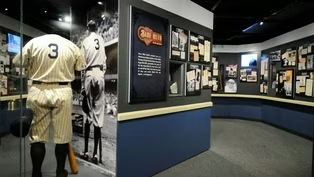
Baseball: Echoes from the Bleachers Preview
Video has Closed Captions
Explore the sport’s most extraordinary stories through the Baseball Hall of Fame’s vaults. (30s)
Providing Support for PBS.org
Learn Moreabout PBS online sponsorship












Support for PBS provided by: