
Red Butte Garden & Arboretum, Hour 2
Season 30 Episode 2 | 52m 24sVideo has Closed Captions
Watch all-new stunning treasures discovered during ROADSHOW’s visit to Salt Lake City, UT!
See stunning treasures from ROADSHOW’s visit to Salt Lake City! All-new finds include a 1970 Rolex “Red” Submariner watch, an 1834 Baltimore St. James Episcopal Church sampler and 1961 Ed Ruscha drawings & letters. Which is the top find?
Problems playing video? | Closed Captioning Feedback
Problems playing video? | Closed Captioning Feedback
Funding for ANTIQUES ROADSHOW is provided by Ancestry and American Cruise Lines. Additional funding is provided by public television viewers.
Support provided by:


Red Butte Garden & Arboretum, Hour 2
Season 30 Episode 2 | 52m 24sVideo has Closed Captions
See stunning treasures from ROADSHOW’s visit to Salt Lake City! All-new finds include a 1970 Rolex “Red” Submariner watch, an 1834 Baltimore St. James Episcopal Church sampler and 1961 Ed Ruscha drawings & letters. Which is the top find?
Problems playing video? | Closed Captioning Feedback
How to Watch Antiques Roadshow
Antiques Roadshow is available to stream on pbs.org and the free PBS App, available on iPhone, Apple TV, Android TV, Android smartphones, Amazon Fire TV, Amazon Fire Tablet, Roku, Samsung Smart TV, and Vizio.
Buy Now

ANTIQUES ROADSHOW's 2026 Production Tour
Enter now for a chance to win a pair of free tickets to one of the three stops on ANTIQUES ROADSHOW's 2026 Tour. Sweepstakes entry deadline is April 6.Providing Support for PBS.org
Learn Moreabout PBS online sponsorship♪ ♪ CORAL PEÑA: "Antiques Roadshow" picked a bouquet of treasures just for you at Red Butte Garden and Arboretum in Salt Lake City.
APPRAISER: Did you know who she was?
No, I do not.
Okay, I found her.
(gasps) You found her?
The plot thickens.
The plot thickens.
(laughs) ♪ ♪ PEÑA: This gorgeous Utah garden is the temporary and temperate home for "Antiques Roadshow" today.
Red Butte Garden is named for the Red Butte Canyon.
It nurtures mostly native plants and trees, as well as plants from other parts of the world that do well in the area's hot, dry summers and cool, wet winters.
What treasures have been transplanted to "Roadshow" today?
This belonged to the owner of the Broadway Shoe Repair in downtown Salt Lake.
It was a little old German guy.
Growing up, my mom would always take my dad's boots to get reheeled down there.
And when we were there, I would play in this shoe.
When he decided to retire, he gave the shoe to me.
It is a fitting shoe for Robert Pershing Wadlow, which was the tallest man in the world at the time.
Robert was 8'11".
GUEST: This is a photo album of my mother-in-law.
She worked at the Jasper Provincial Park, um, in Canada.
We figure about she was 16.
This is her here, and I don't know any of the other people.
Her dad w, was working at a lumber camp in Cold Lake, and I think it was just a summer job to get away from the lumber camps.
She never mentioned it, so we don't really know anything else.
So, it's a nice family heirloom to have.
Yeah.
These pictures documenting her summer working at this camp.
But the reason we're talking... Yeah.
...is that when we turn the page here, we suddenly see this.
So, what can you tell me about this?
(stammers): Well... (laughs) (laughing): Uh, yeah, well, um, my husband was doing just that, looking at this after she passed away.
It was just in a box, and all of a sudden, it's, like, the "River of No Return."
And, and then we were, like, "That sounds like a movie."
(laughs) And so... Mm-hmm.
Um, then they started looking some more, um, at the other pictures.
So, if we continue through here, "River of No Return," 1954, 20th Century Fox film that was filmed on location in Jasper National Park in Canada.
And most importantly, it's a film starring Marilyn Monroe.
(chuckles) Yeah.
She's there with Robert Mitchum and Tommy Rettig.
Actually, Tommy Rettig is the child who played Mark Calder in the film, who was Robert Mitchum's son.
Oh, uh-huh.
Yeah.
Um, so that you have the core group of the key cast members here.
And what I really love about this is, not only did she get a nice, tight shot of them, Marilyn is giving face in this photo.
She is clearly turning it on.
The film came out, and it was an interesting kind of a departure for Marilyn.
She did start the film playing, like, the classic showgirl, saloon girl, but most of the film, she's in jeans.
Yeah.
And if we flip through here, we continue to see more Marilyn Monroe.
Yeah.
This is her here.
This is my mother-in-law with Rory... With Rory Calhoun.
She obviously had access to the set.
We're not sure why.
Mm-hmm.
But she didn't just have access.
She actually was interacting with them in a very intimate way.
We see-- here she is cuddling up with Robert Mitchum.
(laughing): Yeah, that's it.
That's my mother-in-law.
(laughs) She looks pretty happy.
Happy.
I'm sure at 16, to be cuddling up with Robert Mitchum would've been quite a, quite a thing.
(laughs) And then of course, we also have Robert Mitchum's "Love and kisses, Bob Mitchum" signature.
(laughing): Yeah.
Um, and then, my favorite page of this whole book is where we land over here.
Yeah.
And we have the signature.
Yeah.
And we have a great shot of Marilyn right next to it.
And there's, overall, about 28 pictures of her and the, the area while she's on set.
And ten of them have Marilyn in them.
Oh, really?
Okay, I didn't count that.
So, did some counts.
(laughing): Yeah.
Yeah.
We had some people taking pictures on the set, like the person who worked for 20th Century Fox, whose job it was to document things going on in the scenes.
Uh-huh.
Those pictures would be very different from what we're seeing here.
These are very fun, candid, behind-the-scenes photos.
These have never been published.
No.
And what's astounding to me is that she never told anyone.
She didn't.
At auction, we do have records of other things similar to this that have sold.
And because they're unpublished and no one's ever seen these before, until today, we add up, and obviously, the Marilyns have the most value.
Okay.
So those would probably be sold almost individually.
That's how much people value hers.
Okay.
And those would be probably anywhere between $500 and $800 apiece.
Oh, my goodness.
Which, right there, counting up what we have here, is about $6,500.
(chortles) (laughing): Oh, wow!
And then you have this... That was really loud-- sorry.
(both laugh) Then we have this autograph.
This would bring about $3,000 at auction.
Oh, my goodness, oh, wow.
So we're up to $9,500.
(chuckling): Oh, my goodness, okay.
And then everything else would be about $500.
So we're about $10,000 that we would expect it to realize at auction.
Oh, my goodness-- okay.
Wow.
I guess we have to up our insurance.
(laughs) Th... Okay.
I don't know what to say, honestly.
You're editing this out, right?
(laughs) I... Thank you.
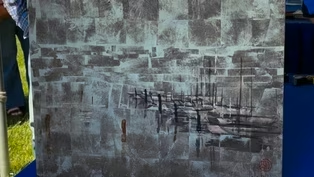
GUEST: My grandparents knew the artist, and things have kind of trickled down to me.
I'm the youngest grandchild of them, and... (chuckling): Nobody else really wanted, uh, a lot of these pieces.
And I have a couple more, uh, larger pieces by him at home, as well.
This is really a marvelous painting by the artist Nguyen Van Minh.
He was born in 1930 and he died in 2014.
Okay.
And he was very, very prolific.
Mm-hmm.
He painted up until maybe ten or five years before he died.
Okay.
And always in this very abstract, thoughtful fashion, and always with this particular seal and signature.
We can date this, 'cause it says '99.
Paintings such as this, of this size and this kind of subject matter, tend to sell for about $6,000 to $9,000.
Wow.
(chuckling): Okay.
Wow.
(laughs) It's incredible.
(laughs) GUEST: I think they came from my great-grandmother's house in Kentucky.
They ended up with my grandma here, and, uh, when she passed away, my dad cleaned everything out, and they almost ended up in the dumpster.
But my wise, brilliant mother saved them from the garbage and had them under her bed for, like, the last 15 years.
I think they are my ancestors, probably from the South, Mississippi area-- Alabama, maybe.
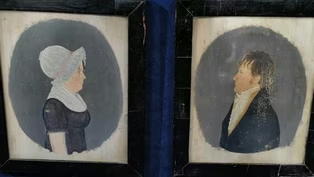
They are wonderful oil-on-board portraits of what we believe to be a husband and wife.
Trying to figure out the date of these, we often will take a look at the sitters' clothing.
And when I look at the woman, in particular, I see this high-banded waist.
We refer to that as the Empire style.
And we see that between about 1800 and 1820.
The gentleman similarly has a outfit that we think of as something from around the War of 1812.
Wow.
So I think this firmly puts it in.
But the big question is, how do we know they're American?
Mm-hmm.
And so one of the ways we, as appraisers, will look at an object is by looking on, what is it constructed on?
By taking a look at the back here, we can see the wood that it was made on.
It's got this sort of greenish tinge, which indicates that it's poplar, a native American wood.
And we often find that in the mid-Atlantic states... Wow.
...and the South.
What I really love about 'em is their condition.
You probably have the original frame, but it's been painted black later.
Mm-hmm.
They are so fabulously painted.
I just absolutely love the lacework on the bonnet, and this pink ribbon running through... Yeah.
...is spectacular.
The lace on her collar, the, the fringe and the lace on his shirt, the way his hair is so stylized.
Mm-hmm.
They're so exquisitely done.
What's different is, if you look at the oval, you see how sort of uneven this line is?
Mm-hmm.
Well, what I expect to have seen would be what we call églomisé glass.
So, it would have been reverse-painted glass, so... Oh.
It would've been black with gilt highlights that would have covered up that uneven edge.
Wow.
With the exception of a little bit of the exfoliation on the gentleman and a little bit of rub on the shoulder here, they're, like, untouched.
And that's what we as collectors... Wow.
...and appraisers love, this sort of original condition.
We tried in the short amount of time to figure out who the artist was, and we weren't able to come up.
Sometimes... Yeah.
...you may be able to find similar profile portraits and ascribe them based on previous attributions.
I think we need to do more research on that.
Right.
I would suggest putting an insurance value of $7,500 on the pair.
Oh, my goodness.
That's more than I thought, wow.
(chuckles) Wow, okay.
They almost got thrown away-- that's amazing.
(chuckling) When you pulled them out of the box... (laughing) ...my heart started beating faster and I couldn't contain my excitement.
I'm glad my mom was smart enough to save them.
PEÑA: Red Butte Garden and Arboretum is part of the University of Utah.
This oak grove has a special connection to the university's history.
Back in the '30s, Walter Cottam was a botany professor at the University of Utah.
He was trialing trees for hardiness, and one of his primary studies was oak trees, oak hybridization.
And about 130 of those original hybrids are still here on the property in an area we call Cottam's Grove.
PEÑA: Acorns are still collected by horticulturalists and sent to researchers around the world.
In this way, the work Dr.
Cottam started decades ago continues.
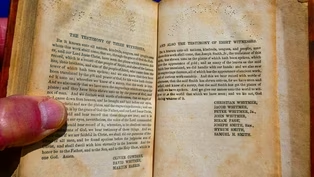
I bought an old "Book of Mormon."
It's an 1840 edition.
And this was in our family.
My grandpa was a collector, and he passed it to my dad, and my dad kept it in the safe.
My mom just passed a, about a year and a half ago.
And that is when we opened the safe.
We always thought it was a, a European edition, but once we opened it, we realized it was not a European edition, but a Nauvoo edition.
Do you know when your grandfather got it, or how he... I believe he bought it in 1972.
Do you have any idea what he paid for it?
I have no idea what he paid for it.
Well, let-let me s... First of all, it wasn't done in Illinois, it wasn't done in Nauvoo.
This edition was actually printed in Ohio.
Oh.
As the Mormons moved west, they were considered a cult.
They weren't welcome almost anywhere they went.
Mm-hmm.
And so they had to keep moving.
They knew they were moving to Illinois when this copy was printed.
The Mormon Church and the LDS, they had been very successful.
And people are very, very interested-- whether it's Mormon or another religion-- very interested in the origins and the history of their religion.
One of the reasons the book is important and very collectible: Joseph Smith was still alive when this edition was done.
And for collectors of the "Book of Mormon," one of the key big factors is, there were four editions printed when he was alive.
He died in 1844.
They want the ones that he was there and saw the printing.
One thing I will mention about this is, this is not the original binding.
My guess would be the binding's 100 years old.
It might be a little bit more-- very nicely done.
The actual book in this is in great condition.
A retail price, $50,000 to $60,000.
(gasps): Oh, wow.
Wow.
(laughs): That's crazy.
That is, that is amazing.
$50,000 to $60,000.
Insurance, I'd probably say $75,000.
Mm-hmm.
If you had come to me with this book 20 years ago, I would say maybe, maybe $20,000.
I consider an honor just to be standing here holding it and, uh, seeing it.
So, thank you.
(voice breaking): Thank you, thank you.
It is a treasure for our family, and having you share this information has been very, very enlightening and very dear to me.
Can I give you a hug?
Sure.
(laughing): Okay, thank you.
If this was the original binding, this would probably be a retail of $75,000.
Wow.
I can't tell you a ton, but I can tell you that it is from 1709.
It is on the bottom.
(laughing): It does say 1709.
And it was my grandmother's.
It's from Hungary, and it has made its way to the United States in the 1960s with my family.
So, that's what I got so far.
(laughing) My wife found it about three years ago at an estate sale, here locally in Salt Lake.
Has no markings of telling us any origins of where it's from, so thought we'd bring it in and, and see what we could learn from it.
We paid about ten dollars for it at the time, so... Hopefully, uh, it's worth more than that.
(laughs) GUEST: It was about 20, 25 years ago.
There was a gentleman that had an antique store in Salt Lake, and he passed away.
And there was an estate sale of his inventory.
And it ran for about three days.
And on the third day, I went back and said, "I think I really like these."
And I purchased them.
Can you tell me how much you had to pay?
It wasn't very much.
It was $150, maybe under $200.
Right around that amount of money.
I think the symbol is Derby, but I'm not positive.
Well, let's take a look at that symbol.
There is a mark on the bottom, and it's a kind of a crown.
It's a rare mark for Derby, but it is a Derby mark.
It was first used in about 1811, when a gentleman named Robert Bloor took over the Derby factory.
And I would date these to between 1811 and about 1815, based on the mark.
They're beautifully painted on the front with English flora.
And then, we'll see on the back, there's nothing, because they're designed, of course, to go up against a wall on a mantelpiece.
What I love about them is that they've survived so well.
I love the little ram's head handles.
They're what we call bough pots-- B-O-U-G-H pots.
And they were a popular thing at the time.
Uh-huh.
Derby made perhaps the best of them.
And you see that, that the top has these little apertures.
The small ones are for little wooden rods, little canes, if you like.
Oh, how interesting.
Uh-huh.
And then the tulips, or whatever you wanted-- croci, perhaps-- but typically, tulips would grow up through the rods and be connected and kept together by them, you know?
Oh... They grew up through these leaf-shaped apertures.
Okay.
Beautiful concept.
So, I love that they stayed together.
I think you did very well when you bought them.
In an antique shop today, they would be a lot more than $150 or $200.
Okay.
I think it'd be fair to say ten times that.
Oh.
Maybe between $1,500 and $2,000... Oh!
...would be the right retail price today.
Oh, that's great.
Yeah, very beautiful pair.
And some of them are painted with landscape.
Oh, okay.
Landscape ones tend to be a little more valuable, actually.
Uh-huh.
But these are really tasty.
This painting belonged to my grandparents.
My grandfather was born in Sanpete County, Utah.
He was a sheep rancher.
He was born in the late 1800s.
My mother tells me that he and my grandmother were traveling to Southern California by car and drove through Arizona on their way, and he would've just picked it up on their way to California.
Do you have any idea when that might have been?
It was probably in the 1950s.
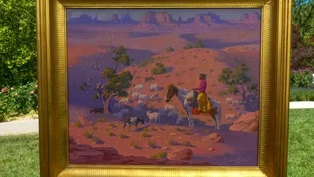
It is an oil painting on canvas.
It's titled "A Pastoral," number one.
It depicts a shepherdess in Monument Valley.
And I did check with the tribal table, and they said that this is a Navajo woman.
And it was done most likely in the 1950s.
It's done by Charles Bensco.
Charles Bensco was a Hungarian-born artist and moved to the United States when he was seven years old.
He was born in 1894.
Uh, he moved to New York, and then he went to L.A., where he was a portrait painter and a muralist.
And then in 1945, went to Phoenix.
When he was in L.A., he was the head of the Society for Sanity in Art.
That was a group of artists.
They were representational artists, and they were very opposed to all of the modern trends in art.
Mm.
Do you have any idea what your grandfather might've paid for the painting?
I have no idea.
His work has shown up at auction, and several very similar scenes to this one have sold in the range of $2,000 to $3,000 at auction.
Wow.
That's incredible.
That is-- that's amazing.
He loved sheep, but he also loved and respected the people who did what he did, too... Right.
...which was to care for them.
Well, that's really lovely.
So... And, uh, and it's a beautiful painting.
It is, it is-- thank you.
I honestly just bought this at an estate sale, like, last weekend, for $50.
Apparently, it's, like, an '80s M&M phone, but I honestly haven't plugged it in to see if it works.
I just thought it was really cool, so I bought it.
So I'm just wondering, like, how much it's worth.
My dad heard from his dad that they were from-- some from the 1800s, and maybe some from the 1700s.
But, to be fair, Pop-Pop was a bit of an embellisher, so we'll, uh... We have no clue, so we're looking to find out.
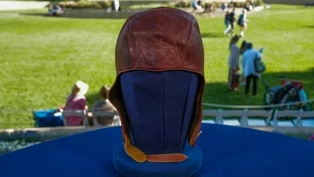
GUEST: This is a helmet that Charles Lindbergh wore, and it was given to my husband's grandfather.
They first met in about 1924, when Charles enrolled in the Army Air Corps, and my husband's grandfather, General Cannon, was one of his flight instructors there.
Then, four years later, they met again at an air show, and General Cannon lent Lindbergh his plane to use in part of the air show.
Wow.
So, at the end of the air show, Lindbergh presented this helmet to him, signed it, then dated it.
Wow, that's an incredible story, and what an amazing gift.
Yeah.
Let's have a close look at it.
What we have is a, is a, is a pretty basic flight helmet for the 1920s.
Uh, simple leather with a, a buckle strap.
And you have these two snap straps in the back that would secure your goggles, so they wouldn't blow away.
Mm-hmm.
And honestly, at this time, its main function really was just to keep your head warm.
And as you mentioned, it also has Lindbergh's signature right here on the side flap.
Mm-hmm.
"Charles Lindbergh," and it's dated September 16, 1928.
Yes.
Incredible.
Lindbergh was a complicated American historical figure.
Uh, right before World War II, he had an isolationist stance, and he did express some anti-Semitic views.
Lindbergh dropped out of college after two years to join a flight school in Nebraska.
After that, he was barnstorming across the country, wing walking, and doing all kinds of daredevil stunts.
Hm.
He joined the nascent Army Air Service around 1924, which is when he would have met your husband's, uh, grandfather.
Mm-hmm.
And made his historic flight solo, nonstop, across the Atlantic, May 20, 1927.
He climbed aboard his plane with a couple canteens of water... (both chuckle) Yeah.
...and I think a, a couple of sandwiches... Yeah.
...and some 33 hours later, landed in Paris.
Mm-hmm.
The moment Lindbergh touched down in Paris, he was an international hero, an automatic celebrity.
From the collector perspective, this is a flight helmet that he would have worn, it is something that was very close to him... Mm-hmm.
...and it's an iconic kind of symbol of early aviation.
Yeah.
So, now we also add to that that he signed it and dated it-- so 1928, September, just a little over a year after the historic transatlantic flight.
Mm-hmm.
So, it ticks a lot of boxes for folks.
I would conservatively say, at auction, we're talking about something around $8,000 to $10,000.
If I were to insure it, I would think we'd be looking at $20,000.
Okay.
Okay.
I collect at thrift stores, estate sales, and things like that.
And it was something that, I went to a thrift store, they said, "Look, it's all beat up.
20 bucks, it's yours."
It's, like, "Okay!"
I thought it was Pennsylvania Dutch.
And somebody told me, "No, it's Asian art," so... I don't think this has anything remotely to do with Pennsylvania... Okay.
...Dutch or German.
Okay.
APPRAISER: This is actually from China, from a very specific province called Shaanxi province... Okay.
...that was known for several things.
One is this very thick lacquer surface.
And they would put lacquer over a soft wood, which is what we have here.
GUEST: Mm-hmm.
APPRAISER: And one of the other features of Shaanxi province furniture, the hinges, they're really thick, heavy, wrought iron.
GUEST: Mm.
APPRAISER: I suspect that what someone did is, they went over the original design that had deteriorated quite a lot.
Uh-huh.
What do you think this dates to?
Thinking 1800s?
Yeah, about.
I'd say somewhere between 1880 and 1920, because it's got a lot of character.
In a retail sense, I would imagine somebody would ask somewhere in the $700 or $800 range for it.
Yeah.
Uh-huh.
Because it's got a lot of flair and it's got nice color.
GUEST: I brought with me several small pieces that were gifted to my mother by Ed Ruscha, the artist.
She was living in the West Village in New York City, uh, in a little apartment on Bleecker Street, a two-bedroom with four people living in the apartment.
Her roommate's mother was friends with Ed Ruscha's mother, uh, from Oklahoma, and he was returning from a trip from Europe.
He needed a place to stay.
Her mother reached out to, mother-to-mother, said, "Can Ed crash on your sofa?"
He stayed with them for a few days while he waited for his, uh, car to be delivered from Europe.
While he was there, he gave them this piece and this one, and then later, uh, wrote these letters to them, and, uh, gave my mom this piece, which is actually a, a drawing of her car.
She had gotten in a fender bender, and the funny story behind that is that the woman who she had run into immediately got out of the car and walked up to her and, you know, extended her hand to shake her hand and said, "It's so nice to meet you."
(chuckles) And so the copy that he put on there is pretty playful.
He kind of made a mock ad and talks about, it's a great way to meet people, is to get into minor collisions in your VW.
The visit was in the fall of 1961, and then the letters' postmark is December.
So they stayed in touch for a couple of months after.
I think she was curious and wanted to get them, uh, authenticated.
And so she looked up his gallery and wrote to the Gagosian Gallery, and sent a letter with photocopies of them.
And apparently, they forwarded it to Ed.
And she got a voicemail message from his studio manager saying, "Yes, Ed remembers you, and he remembers those pieces."
Ed Ruscha is one of the most important artists of the 20th century.
He was born in Omaha, Nebraska, in 1937 and spent a lot of his time in Oklahoma City, but in 1956, moved to Los Angeles.
So we really think of him mostly as a California artist.
What I find really fascinating about this group is that we are seeing the early stages of him playing with text... Mm-hmm.
...and words.
His best-known works today are paintings and drawings of words.
He has taken something as simple as a word and elevated it... Mm-hmm.
...raising it to a level that makes you stop... Mm-hmm.
...and think a little bit deeper about language and culture.
Some of his most important paintings from the early '60s were of the word "scream."
Mm-hmm.
And I don't know if this was the first time he utilized "scream," but it certainly was, was very early.
We have two letters here.
There's a smaller one that's still in the envelope, which is pencil on paper.
And then we have on display here the larger letter.
My first reaction was, these are also works of art.
He's using different-color marker for different words.
He puts that ampersand right in the center, very bold.
And so visually, it's very interesting.
Mm-hmm.
This one closest to me is a self-portrait of Ed Ruscha.
Mm-hmm.
It's watercolor and graphite on paper.
I don't think I've ever seen a self-portrait that he made.
Mm-hmm.
Tell me a little bit more about, uh, the, the advertisement that he gave and left behind to your mom and the roommate.
Mm-hmm.
This was an ad that he had designed and that he's actually in.
That's him, the cowboy.
The thought bubble that he customized it with is the names of my mom and her roommates.
Ed Ruscha has museum shows and is shown by some of the most successful galleries in the world.
Mm-hmm.
And so his notoriety and desirability continues to grow.
This letter that we see here, I would put an auction estimate of $3,000 to $5,000.
The smaller sheet, which is in the envelope still, I would put an auction estimate of $2,000 to $3,000 on that letter.
Hm, okay.
The self-portrait, $10,000 to $15,000.
Okay.
The collage, also $10,000 to $15,000.
Okay.
And then we have the drawing of the Volkswagen car.
This one really, you can see where the jump-off points were for the rest of his career.
Mm-hmm.
Where he's dealing with cars and text... Mm.
...and all of the things that we really come to recognize as being what he is best known for.
An auction estimate on this I would suggest should be $20,000 to $30,000.
Great.
(chuckles) Wow.
That's great.
CRYSTAL KIM: The Fragrance Garden is a wonderful spot here at Red Butte Garden.
It is one of three of our terrace gardens that were some of the foundational gardens here.
It is designed with a central meadow and flagstone path throughout that is bordered on the outside with trees and flowering shrubs.
Some of the things that are blooming right now are peonies, perennials like yarrow.
All types of fragrance are present there.
The meadow is just a beautiful, flowery place.
GUEST: In 1952, at age ten, I started collecting cards.
My grandfather gave me a job of gathering snails in his garden.
Mm-hmm.
(chuckles) And I was given five cents a, uh, jar.
And so I had cash in my pocket.
I walked down to this store and bought a pack of cards, opened it up.
There was the one card we really had never seen before.
There was Mickey.
Okay.
And it's never, never been out of my, um, possession.
You have the 1952 Topps Mickey Mantle, card number 311.
Mickey Mantle played between 1951 and 1968, all for the New York Yankees, Hall of Fame outfielder, inducted into the Hall of Fame in 1974, 536 career home runs, and one of the most popular players in the history of baseball.
The Mickey Mantle card here is the most sought-after card in all of card collecting, for the vintage cards.
It's one of Mickey Mantle's rookie cards.
The '51 Bowman came out one year earlier.
Right.
The '52 Topps still is considered a rookie card.
I would say 99.9% of the time, when cards come into "Antiques Roadshow," they're just like this.
They're raw or ungraded.
When you see this card come up for market or get valued, it's been graded.
In the last five years, all 85 of them that have sold at auction were professionally graded.
That doesn't surprise me.
You're a purist about the card being in its original state.
There's no question about it.
The market really is pushed by gr, the graded market on a card like this.
Well, that's what some people think.
When we talk about this card, and talk about the graded value versus the ungraded value, the card is going to carry more value when it's graded.
When that card goes to the professional grader, first of all, they're going to verify the authenticity.
They're going to be able to measure it to make sure it hasn't been trimmed or altered.
They're also going to be able to check it under black lights... That's right.
...to make sure it hasn't been embellished or hand-colored.
Then, after all that's done, they're going to assign a numerical grade on it.
Mm-hmm.
And then they're going to encapsulate it.
That's right.
What do you, what do you think about that?
(scoffs) It's a burial-- they put him in a coffin.
(chuckles) Okay.
What I love about it is the coloring.
It's so bright, and the centering is nice, too.
When I pull out the high-power magnification, that's when I detect wear, just a little bit, on three of the corners, the worst being the lower left corner.
This card here, in my opinion, is a VGX4.
Okay.
And this card, in this condition, at auction, they sell for $40,000 to $50,000, ungraded.
Well, the last one that I knew, August of 2022, that sold for $12.6 million?
Mm-hmm?
If that card was right here and my card was here, I'd pick my card up.
Hm.
So that's how I put value on things.
Because I know it's authenticity.
Right.
This card, professionally graded, assuming it gets that same grade... Mm-hmm.
...of a very good- excellent condition, they typically sell at auction for $65,000 to $75,000.
It was my husband's grandfather's, and we don't know where he got it.
I'm guessing that it's either used for water or... I don't know.
That's why I'm here, to find out more about it.
We brought in some old quarantine flags.
We paid $100 for both of them.
I think they're from the 20s, but, I honestly don't know.
Yeah, we're kind of curious to find that out.
(laughs) GUEST: Just this last Christmas, my cousin was helping my grandparents go through, um, one of their storage rooms, and they pulled this doll out.
It looks like it never had been opened or touched.
And my grandma was, like, "Oh, it's a new Barbie doll."
And she actually was going to give it to one of my cousin's daughters, who's eight.
And I was, like, "Oh, can I come look at it?"
Just from what my knowledge is, I think this could be valuable.
So I was, like, "Maybe hold off on giving it as a birthday present."
(both chuckle) My grandma doesn't even remember buying it.
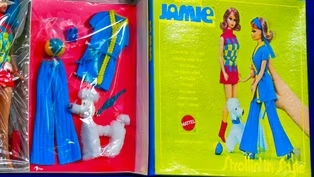
Probably bought in the early '70s, maybe for my mom or for one of her sisters, so... What you have is a Walking Jamie doll, and it's called Strollin' in Style.
She's in the Barbie family.
And Walking Jamie was made by Mattel exclusively for Sears.
This was a doll that you would find in the "Sears Wish Book."
Okay.
It only came out during the holiday season.
And this box just really illustrates the time period.
Um, even the graphics on it are very 1970s.
Yeah.
And then what's even more fun is when we take the lid off the box, and surprise, look at this.
(chuckles) I mean, it's just, like, Christmas Day 1972 all over again.
Never been out of the packaging.
Still has the original cellophane over her.
And the colors... Yeah.
...are so vibrant.
This is a time capsule of the period.
Yeah.
There was one edition before her, it was different colors.
The clothing was oranges and yellows, and the dog was actually gray instead of white.
And they were only made between 1970 and 1972.
Okay.
And you can see Jamie.
She's a beautiful doll.
I mean, she's got a beautiful face.
Mm-hmm.
And she's the first Barbie's friend that they actually used a Barbie mold to create her.
Oh, interesting, okay.
Everybody else had their own mold.
She's got a button on her back, and if you... Okay.
...push the button, she actually moves her arms and legs and turns her head.
Okay.
And all this brilliant engineering was done, created by a man named Jack Ryan that worked for Mattel, and he designed the Barbie dolls all through the '60s and '70s.
Mm-hmm.
Value-wise, it's hard to find her because... Yeah.
...there just weren't that many out there.
And then, it's just in beautiful condition.
They just rarely exist.
Your Jamie, her retail value would be somewhere between $1,800 and $2,200.
Wow.
Wow, that's amazing.
Thank you.
(chuckles) GUEST: I've got this vintage Rolex that I understand is from about 1970.
Here in Salt Lake, there's a local company that does primarily online auctions, but they also have a small brick-and-mortar retail operation.
I found that in there one day, and they had it priced fairly high.
So I wanted to do some research and due diligence.
Mm-hmm.
And ended up deciding it was worth risking the $2,800 that I spent on it at the time, in about 2010.
I really, uh, admired the Rolex Red Submariners... Mm-hmm.
...for a long time.
And especially the ones with the, kind of the ghost number dial on the, around the outside.
In the last few years, a lot of things have changed.
These older models certainly have gone up in price.
Mm-hmm.
This particular model is the 1980.
It was actually built in 1970, like you said.
Okay.
Um, it has a special red "Submariner" on the dial.
There was about 11,000 pieces made.
They started making the Red Submariner in 1967.
This is, like, the fourth generation of this dial.
They made about seven different generations up until about 1976.
So the watch also features a large date aperture.
So you have a large date, it's easy to read under the water.
It has luminous hands, markers, which was also used for diving purposes.
Then you also have the, the diver bezel, which is 0 to 60.
You could do minutes or seconds off that bezel, also for diving purposes.
Do you wear it often?
Not very much.
Mm.
Yeah, I just take it out and admire it now and then.
(both chuckle) You should wear it-- it's a great watch to put on and wear around.
Okay, I'll do that.
Did you ever have this watch appraised?
Uh, about the time I bought it, maybe a year later, I had it appraised by the local Rolex dealer for insurance purposes for about $8,000.
I can value this watch, nowadays, for about $25,000 at retail value.
Oh, my goodness.
Yeah.
(chuckles) I'm... Wow.
(chuckles) I had no idea.
That's outstanding-- wow.
But I would have it appraised for close to $30,000.
For insurance purposes?
Yes, for insurance purposes.
Great.
Okay?
All right-- I'll call my insurance man right now.
Yeah.
(both chuckle) The bezel alone is worth $3,000.
(chuckling): Oh, my goodness.
My mom grew up next door to a woman in Georgia, and in the early '70s, she bought a player piano from her.
When she went to buy the player piano, the woman gave her this painting, also.
When my parents downsized, my mom gave the painting to me.
She lives in our house now.
She hangs on the mantel.
Yes.
(chuckles) She lives on the mantel.
This is my dad's guitar.
We lived in Burlington, Vermont, and my uncle came to visit, and he happened to see this in a window of a music store.
The salesman explained that it was a very unique guitar, brand-new for Fender, it was a brand-new line.
They take an electric, uh, guitar neck and put it on a body of an acoustic guitar.
He loved it, but he couldn't afford it, so he talked my mom into buying it as a gift for my dad.
And ever since then, they, uh, whenever they'd get together, they would play for hours and hours.
My dad played the harmonica, and they would play until the middle of the night.
So I have some very fond memories of this guitar with my dad and my uncle.
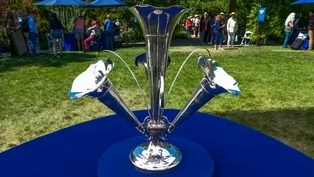
This is a silver "epergné," I believe.
It's a centerpiece for a lovely flower arrangement.
I inherited this from my mother, who i, inherited it from her great-aunt.
It's just been in the family for the last 60 years.
Any ideas on where great-aunt may have gotten it?
She and her husband, who I believe was a diplomat, uh, did live in China for a period of time, I believe between the '40s and '50s.
And she acquired it then, along with some other silver pieces.
Do you have any idea what she paid for it?
No, no idea whatsoever.
(chuckles): Now, when you first came to the table, I immediately thought, "Why on Earth did they send this to Asian art?"
Because this is very much so a European form, an English form.
Mm-hmm, yes.
And it's "epergne."
(chuckles) There you go.
Now, epergnes are absolutely used for flowers.
They're floral display vases.
Every single one of these vases has a separate motif.
And looking at them, my colleague and I immediately thought... (snaps fingers) "Japanese."
Ah.
But it's not Japanese.
Aha, the plot thickens.
The plot thickens.
(laughs) The English vase that looks Japanese is actually Chinese.
(exclaims) On the base, there is a mark.
Now, every single piece comes off.
And when we look at the base, we have a little mark.
Aha.
Oh, I see it.
It says "Shanghai Qingyun Company."
The Qingyun Company was active from 1783 to between 1890 and 1900.
Mm.
I would say this most likely dates to the late 19th century... Ah.
...1880 to 1900, to what's, uh, called Guangxu period.
In the Qing Dynasty.
Wow.
Japanese craftsmen were in China.
Aha.
The Chinese craftsmen were going to Japan because they were trying to figure out, what do Europeans and Americans want?
So looking at each, there's an, a different motif.
On this one, we have bamboo.
Bamboo is indicative of strength of character.
Uh-huh.
They're the three friends of winter.
Interesting.
Over here, we have irises.
Here we have cherry blossoms, plum blossoms.
And finally, in the center, the strong pine tree, who's resilient and can last through the winter.
It looks Georgian, but the mark on the base tells us a different story.
And the decoration on it tells us a different story.
What I would estimate it would sell for at auction today is between $2,000 and $4,000.
Nice-- that's excellent.
Thank you so much.
Great news.
The family would be proud.
(chuckles) And now they might want to know who's getting it.
(both laugh) Now, I just wish we could put some flowers in it.
(laughs) We could go get some, yeah.
We might get in trouble.
(laughing): Yeah, absolutely.
KARA HASTINGS: Penstemon is one of the most recognizable plants here in Utah.
There are 280 species in the United States.
Over 100 of them can be found right here in Utah.
They're known as beardtongue, and it's because they have this long, little staminoid, and it kind of sticks out like a tongue.
And then it has this little tubular petal that makes it kind of look like a beard.
And it's highly specialized for hummingbirds and bees.
It's an incredibly adaptable plant.
They can tolerate wet, they can tolerate dry.
They do prefer well-draining soils, but you will find some species everywhere in Utah.
This is a painting from a local painter here that I acquired from a friend.
We've had it for eight or nine years.
My understanding was the painting was, um, from a view of the Capitol in Salt Lake City, kind of facing down towards Main Street, which obviously would have been a long time ago.
And the artist?
Gary Smith.
This is an oil-on-board painting by one of the more well-known contemporary Mormon artists living today.
Mm-hmm.
He is from Oregon o, originally.
Uh-huh.
But he, he lives around here.
Yes.
And he's painted around here a lot.
Mm-hmm.
And has done a lot for the temples.
He was actually director of the gallery at Brigham, uh, Young University.
The painting's not dated.
I think it, it's probably from circa 2000.
Mm-hmm.
The artist was born in 1942-- he's still active.
It could be topographical, but I think what it really shows is this artist at, at his best.
He's very well known for his use of simple composition, strong colors and forms, and imbuing a certain kind of spiritual sense... Mm-hmm.
...into his landscapes, with ideas such as connection to God, connection to hard work, connection to the West and to the history of the American West.
A lot of artists, their ultimate goal is to achieve something a little bit more, a little bit higher, uh, something closer to the spiritual plane.
And, and, and in doing so, using their own medium.
I know that this artist has written about working in that way.
Mm-hmm.
But it's also something that's, you can see.
It, it has this vibration-- vibration of colors, vibration of movement, vibration of form-- that just altogether makes a, a, a really whole, complete artwork.
He's important.
He's important as a contemporary artist.
He's important as a Western artist.
He's important as a Mormon artist.
Have you, have you ever had it appraised?
Shortly after I acquired it, I was offered $2,000, and said, "You know, no, "it's probably got a lot more meaning... Mm-hmm.
...than $2,000."
A conservative auction estimate on this would be about $8,000 to $12,000.
Mm-hmm.
Wow.
Way better than what I was offered.
That's great.
It could go higher.
Well, thank you.
It brings a lot of joy.
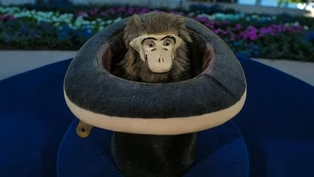
GUEST: After my grandpa retired, he started, um, refurbishing music boxes.
So he collected hundreds throughout the years.
And when he passed away, all of the grandkids got one or two of their favorites.
And you said you wanted the monkey in the hat.
Monkey in the hat.
All right!
It was a popular one.
(both laugh) So do you know anything about its origin, who made it, its manufacturing date, anything like that?
I have absolutely no clue.
All right, well, what I can tell you is that it's French.
It was manufactured by a firm, uh, called Roullet and Decamps, operating out of Paris.
Um, they were in operation from mid-1800s all the way through, uh, late 20th century.
So what we have here is a monkey in a hat.
And what you would do is, you would wind up this mechanism right here with the key.
And you would depress this little button here.
Why don't you give it a play?
Let's see how it works.
All right.
There he goes.
There we go.
(tune playing) The monkey that is inside would pop out.
He would bare his teeth, grin, go up and down.
And this monkey itself is made out of animal fur, likely rabbit.
It's got a leather face with glass eyes.
Do you have any idea of the value, what you think it might be worth?
I have absolutely no idea.
Well, at auction, I would probably estimate it in the range of $1,500 to $3,000.
All right, that's great.
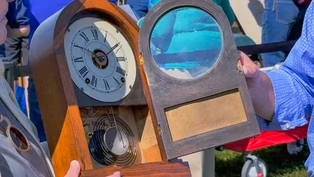
(tune playing) (chuckles) This is my great-grandfather's clock.
And there's a very interesting message inside.
"I bought this clock in 1867 "for $16.
"Whosesoever hands it may come into, "he and successors can see how many generations it will go on running."
And it has gone on running.
This is a Seth Thomas clock.
And the interesting story about this clock is that if you look at the label, it says "Seth Thomas, Thomaston, Connecticut."
And he started in Plymouth Hollow.
Whoa.
And in 1865, the town was so grateful for all the people he employed that they renamed the town Thomaston in 1865.
So you know that this was made right after 1865.
Uh-huh.
It is in great condition.
And this clock would sell, retail, for about $550 to, in today's market.
That's, that's great.
We treasure it.
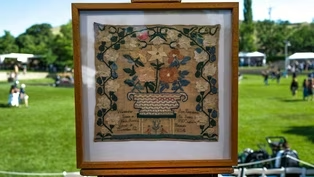
This is an African American schoolgirl sampler that was made in Baltimore in 1834.
I went to an estate moving sale about six or seven years ago, and I saw it there, and, uh, I was struck by the design.
I just loved it.
And what'd you pay for it?
$150.
I love pieces like this because first of all, there's always a lot of information on the sampler: the name of the child that worked it and possibly even the school where it was made.
And pieces like this almost are portals.
Yes.
They take you back to a time and to a place.
And in this particular case, it's Baltimore, and it's 1834.
There was a gentleman who came from Philadelphia.
His name was William Levington.
Reverend Levington was Black, educated in Philadelphia, ordained there.
Came to Baltimore with the purpose of starting the St.
James Church.
And he opened up in Baltimore, south of the Mason-Dixon Line, a school for freed Black children.
But there were children of enslaved Black people.
The school philosophy was to teach both.
Very, very progressive, very, very forward-thinking.
So let's look at this beautiful needlework.
You have a piece that is all silk on a piece of linen.
It says "Worked by Ann Elizabeth Smith."
Did you know who she was?
No, I do not.
Okay, I found her.
(gasps) You found her?
I did.
She was the only person with the name of Ann Elizabeth Smith in Baltimore in 1834.
She was born in 1822.
So she was 12 years old when she made this sampler.
(exhales) And you see, it says "Ann Elizabeth Smith, the first African P.E.C."
-- that's Protestant Episcopal church-- "School in Baltimore, November 12, 1834."
It's beautifully done.
This basket of flowers, the vine that runs around the whole thing... Mm.
...and the whole canvas is filled.
Very powerful piece.
So, what's it worth?
There's only, prior to today, only three samplers that are known from that school.
Yes.
That's it.
And one of them was made by the Reverend Levington, who ran the school.
Reverend Levington's sampler, looking very similar to this... Mm.
...a little more developed... Yes, yes, I've seen it.
...uh, a little more colorful, is now at Colonial Williamsburg.
The other two known are also in institutions.
Yes.
So, Dave, you own the only one in private hands.
I would put a retail value on it of $75,000 to $85,000.
Thank you, Allan, thank you very much.
I look at this every day, and every day, it, it brings me joy and it brings me hope.
PEÑA: And now it's time for the "Roadshow" Feedback Booth.
I brought this Utah history book.
It was worth, like, 50 bucks, but it's pretty cool.
(laughs) And I brought a bag of German pub coasters, and they are worth pretty much nothing.
(laughs) But this one has my name on it, and I thought that was pretty sick!
Yeah, and we had so much fun.
We traveled 900 miles to get here.
And we brought our steins, which are worth $1,500, and some other items worth almost $5,000.
So we are gonna go fill these babies up and celebrate.
Cheers!
Cheers!
I have a, a Gary Collins here from the, the early '80s that was traded to my father in exchange for some upholstery work.
Growing up, my dad always said, "This is your college fund, Eric.
This is what's gonna pay for you to go to school."
Turns out it's about $1,500 on a good day.
You can sleep easy, Dad.
We don't need to store it with so much ease anymore.
We brought a 1920 silver-plated cigarette holder, and the guy said he thinks the dog got to it.
(chuckles) I found it at a, uh, estate sale for $25, with the little case-- it's worth $25.
I got this for $400, it's worth $700.
It's a, a local artist, Florence Ware.
And then our neighbors sold us this, and we were deciding whether or not we were going to stay friends with them, so... (chuckles) They sold it for $600, it's worth $1,000 to $1,200, so... We'll have dinner, yeah.
We'll be having them over for dinner.
(both laugh) (chuckles) We brought a political propaganda poster, 'cause I was hoping to meet Nicholas Lowry.
(exclaims): And I did!
I was so excited!
(laughs) (screams) (others laughing) PEÑA: Thanks for watching.
See you next time on "Antiques Roadshow."
Appraisal: 1834 Baltimore St. James Episcopal Church Sampler
Video has Closed Captions
Clip: S30 Ep2 | 3m 32s | Appraisal: 1834 Baltimore St. James Episcopal Church Sampler (3m 32s)
Appraisal: 1840 Book of Mormon
Video has Closed Captions
Clip: S30 Ep2 | 2m 40s | Appraisal: 1840 Book of Mormon (2m 40s)
Appraisal: 1867 Seth Thomas Round-top Shelf Clock
Video has Closed Captions
Clip: S30 Ep2 | 1m 2s | Appraisal: 1867 Seth Thomas Round-top Shelf Clock (1m 2s)
Appraisal: 1928 Charles Lindbergh-signed Flight Helmet
Video has Closed Captions
Clip: S30 Ep2 | 3m 2s | Appraisal: 1928 Charles Lindbergh-signed Flight Helmet (3m 2s)
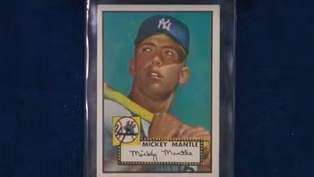
Appraisal: 1952 Topps Mickey Mantle Card
Video has Closed Captions
Clip: S30 Ep2 | 3m 1s | Appraisal: 1952 Topps Mickey Mantle Card (3m 1s)
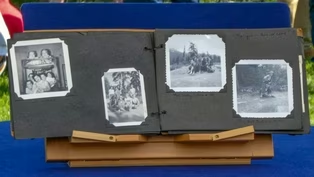
Appraisal: 1953 Marilyn Monroe "River of No Return" Set Photos
Video has Closed Captions
Clip: S30 Ep2 | 4m 3s | Appraisal: 1953 Marilyn Monroe "River of No Return" Set Photos (4m 3s)
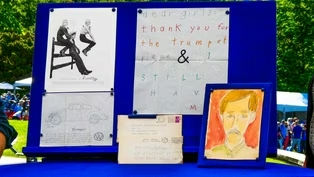
Appraisal: 1961 Ed Ruscha Drawings & Letters
Video has Closed Captions
Clip: S30 Ep2 | 4m 25s | Appraisal: 1961 Ed Ruscha Drawings & Letters (4m 25s)
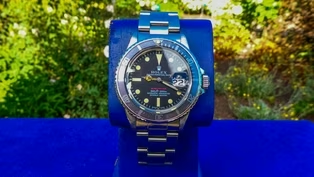
Appraisal: 1970 Rolex "Red" Submariner Watch
Video has Closed Captions
Clip: S30 Ep2 | 2m 26s | Appraisal: 1970 Rolex "Red" Submariner Watch (2m 26s)
Appraisal: 1999 Nguyễn Văn Minh Silver Foil & Lacquer Painting
Video has Closed Captions
Clip: S30 Ep2 | 1m 4s | Appraisal: 1999 Nguyễn Văn Minh Silver Foil & Lacquer Painting (1m 4s)
Appraisal: American Folk Art Oil Portraits, ca. 1810
Video has Closed Captions
Clip: S30 Ep2 | 3m 4s | Appraisal: American Folk Art Oil Portraits, ca. 1810 (3m 4s)
Appraisal: Charles Bensco "A Pastoral" Oil Painting, ca. 1950
Video has Closed Captions
Clip: S30 Ep2 | 2m 17s | Appraisal: Charles Bensco "A Pastoral" Oil Painting, ca. 1950 (2m 17s)
Appraisal: Chinese Export Silver Epergne, ca. 1890
Video has Closed Captions
Clip: S30 Ep2 | 3m 40s | Appraisal: Chinese Export Silver Epergne, ca. 1890 (3m 40s)
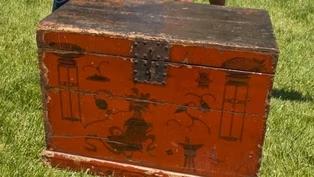
Appraisal: Chinese Lacquer Chest, ca. 1900
Video has Closed Captions
Clip: S30 Ep2 | 1m 29s | Appraisal: Chinese Lacquer Chest, ca. 1900 (1m 29s)
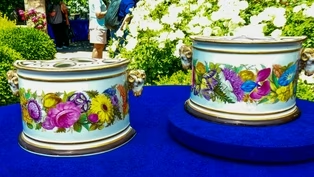
Appraisal: Derby Porcelain Bough Pots, ca. 1815
Video has Closed Captions
Clip: S30 Ep2 | 2m 24s | Appraisal: Derby Porcelain Bough Pots, ca. 1815 (2m 24s)
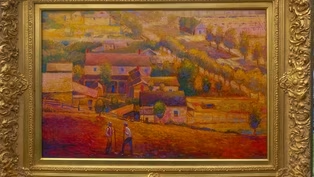
Appraisal: Gary Ernest Smith Oil Painting, ca. 2000
Video has Closed Captions
Clip: S30 Ep2 | 2m 26s | Appraisal: Gary Ernest Smith Oil Painting, ca. 2000 (2m 26s)
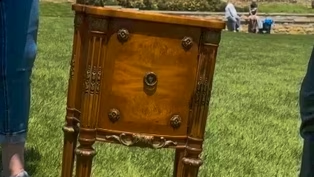
Appraisal: Landstrom Co. Louis XVI-style End Table, ca. 1935
Video has Closed Captions
Clip: S30 Ep2 | 1m 4s | Appraisal: Landstrom Co. Louis XVI-style End Table, ca. 1935 (1m 4s)
Appraisal: Roullet & Decamps Musical Automaton, ca. 1900
Video has Closed Captions
Clip: S30 Ep2 | 1m 44s | Appraisal: Roullet & Decamps Musical Automaton, ca. 1900 (1m 44s)
Appraisal: Sears-exclusive Walking Jamie Doll, ca. 1971
Video has Closed Captions
Clip: S30 Ep2 | 2m 46s | Appraisal: Sears-exclusive Walking Jamie Doll, ca. 1971 (2m 46s)
Preview: Red Butte Garden & Arboretum, Hour 2
Video has Closed Captions
Preview: S30 Ep2 | 30s | Preview: Red Butte Garden & Arboretum, Hour 2 (30s)
Providing Support for PBS.org
Learn Moreabout PBS online sponsorship
- Home and How To

Hit the road in a classic car for a tour through Great Britain with two antiques experts.














Support for PBS provided by:
Funding for ANTIQUES ROADSHOW is provided by Ancestry and American Cruise Lines. Additional funding is provided by public television viewers.