
Māhū, The Most Controversial Word In Hawaiian
Clip: 9/3/2026 | 2m 10sVideo has Closed Captions
What does it mean to be māhū? Kumu Patrick Makuakāne shares why it's the name of his show.
Kumu Patrick Makuakāne, Kumu Hinaleimoana Wong-Kalu, and Kaumakaiwa Kanakaʻole explains what māhū has been through history to present-day.
Problems playing video? | Closed Captioning Feedback
Problems playing video? | Closed Captioning Feedback
Funding provided by the Corporation for Public Broadcasting and the National Endowment for the Arts.
Māhū, The Most Controversial Word In Hawaiian
Clip: 9/3/2026 | 2m 10sVideo has Closed Captions
Kumu Patrick Makuakāne, Kumu Hinaleimoana Wong-Kalu, and Kaumakaiwa Kanakaʻole explains what māhū has been through history to present-day.
Problems playing video? | Closed Captioning Feedback
Where to Watch Pacific Heartbeat
Pacific Heartbeat is available to stream on pbs.org and the PBS app.
Providing Support for PBS.org
Learn Moreabout PBS online sponsorshipPATRICK: Calling the show 'Mahu', the word itself, probably the most controversial word in all of Olelo Hawaii, if you were to think of one word.
Because everybody who sees that word is going to have a reaction to it, whether, "Wow, this should be fun," and curious, to "Oh my God, I'm not gonna see that show."
Also too, I was curious as to how it was going to play out in San Francisco, where people don't know that word.
And nowhere on the information regarding the concert, on the flyers or advertisements, did I say anything about transgender.
HINALEIMOANA: Mahu speaks to the person, the individual, whom straddles a space between gender binary, male and female.
How each person's duality is either manifest or not.
How their duality might be more one sided than the other.
Everyone is different.
There's no cookie cutter for people who are mahu.
There's a broad and encompassing inclusive spectrum.
KAUMAKAIWA: The term "mahu" in a ritual Hawaiian context, refers to the state of becoming.
What?
Who knows?
PATRICK: And we don't have a lot of information, historical information as to how it was used exactly.
And that's why our show opens with the story of Kapaemahu who were four healers who came from Tahiti to Hawaii, and it says that they were mahu.
And there were, there was a big controversy because there are these huge rock stone monuments in Waikiki, as an expression of gratitude, because these healers healed a lot of people and shared their wisdom with the people of Oahu in this area.
And they put a plaque on it, told the story about them, but left out that they were mahu And that's essential to the story because as healers, to be mahu allows them the capacity to draw in from both the male and female side, especially when you're 'pule', when you're pule or when you pray to your akua, you have male and female akua attending to you.
So that makes you very powerful.
 New
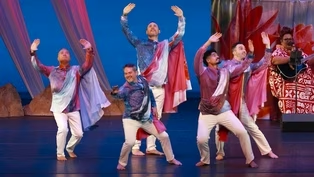
NewA Beautiful Dance Performance by Kumu Patrick's Men Dancers
Video has Closed Captions
Kumu Patrick Makuakāne designed his show to be inclusive in dance, song, and costume. (2m)
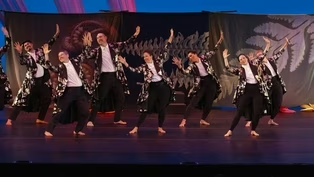
Māhū: A Trans-Pacific Love Letter Preview
Video has Closed Captions
New theater production by Kumu Hula Patrick Makuakāne reclaims and celebrates māhū people. (30s)
Providing Support for PBS.org
Learn Moreabout PBS online sponsorship










Support for PBS provided by:
Funding provided by the Corporation for Public Broadcasting and the National Endowment for the Arts.