
J. Edgar Hoover and the FBI Fight the War on Crime
To win the new war on crime, the FBI sets their sights on famous targets like John Dillinger.
From
J. Edgar Hoover and the FBI Fight the War on Crime
Clip: Episode 3 | 7m 17sVideo has Closed Captions
To win the new war on crime, the FBI sets their sights on famous targets like John Dillinger.
Franklin Delano Roosevelt takes the presidency, and in his sweeping new agenda creates a new agency: the FBI, headed by J. Edgar Hoover. Hoover and the FBI launch a massive campaign to aggressively fight crime employing statistics and fingerprinting to track criminals. The FBI also set their sights on the biggest criminals of the day, such as John Dillinger and Bonnie and Clyde.
From
Problems playing video? | Closed Captioning Feedback
Problems playing video? | Closed Captioning Feedback
Episodes presented in 4K UHD on supported devices. Major funding for CRIME AND PUNISHMENT IN AMERICA was provided by The Atlantic Philanthropies, Emerson Collective, The Andrew W. Mellon Foundation, and...
J. Edgar Hoover and the FBI Fight the War on Crime
Clip: Episode 3 | 7m 17sVideo has Closed Captions
Franklin Delano Roosevelt takes the presidency, and in his sweeping new agenda creates a new agency: the FBI, headed by J. Edgar Hoover. Hoover and the FBI launch a massive campaign to aggressively fight crime employing statistics and fingerprinting to track criminals. The FBI also set their sights on the biggest criminals of the day, such as John Dillinger and Bonnie and Clyde.
From
Problems playing video? | Closed Captioning Feedback
Where to Watch Crime and Punishment in America
Crime and Punishment in America is available to stream on pbs.org and the PBS app.
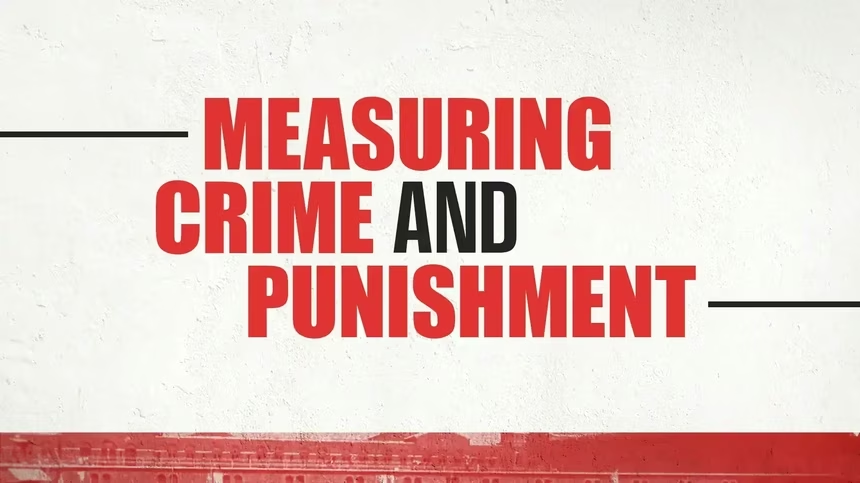
Measuring Crime and Punishment
How does the way we collect and measure crime shape our understanding of it? Crime statistics can tell us how crime changes over time. But the way crime is measured, defined, and communicated can also shape public perception and policy.Providing Support for PBS.org
Learn Moreabout PBS online sponsorshipRoosevelt: So first of all, let me assert my firm belief that the only thing we have to fear is fear itself, nameless, unreasoning, unjustified terror which paralyzes needed efforts to convert retreat into advance.
Narrator: In 1933, President Franklin Roosevelt was inaugurated, promising a New Deal for the American people.
His goals were ambitious: stimulating the economy, saving the nation's banking system, and putting social programs in place to ease the ravages of the Depression.
He also signed the 21st Amendment, repealing Prohibition, and he declared a war on crime, vastly expanding the federal government's jurisdiction and its law enforcement capabilities.
Roosevelt approved new federal prisons, including a fortress in San Francisco Bay where Al Capone would eventually be sent for tax evasion-- Alcatraz.
Beverly Gage: Alcatraz was designed to illustrate and affect this story of specially dangerous criminals who needed to be isolated from American society-- these kind of super villains, who were going to need their own sort of supermax prisons and, in fact, their own forms of law enforcement.
Rebecca McLennan: In the space of about two or three years, no fewer than 10 federal statutes were passed creating new federal crimes, including grand theft auto, the Lindbergh Act criminalizing interstate kidnapping.
So New Deal liberalism involves building prisons and building out the policing power of the state.
Narrator: Several law enforcement agencies-- the Bureau of Investigation, the Prohibition Bureau, and the fingerprint division-- were merged into one: the Federal Bureau of Investigation.
To run the FBI, the president chose the bureaucrat who had gotten his start rounding up suspected radicals after the First World War: J. Edgar Hoover.
Hoover would stay in the job for four decades and become the most powerful law enforcement official in American history.
The Federal Bureau of Investigation is waging and will continue to wage a relentless warfare against crime and criminals, dedicated to one purpose and one alone-- the protection and safety of the law-abiding citizens.
Gage: It's really in the 1930s that the FBI fully enters criminal law enforcement in the ways that we think about it doing today.
The FBI is sent into bank robbery; it's sent into kidnapping cases that cross state lines, a whole series of new areas of jurisdiction.
Narrator: The Bureau also focused on statistics, collecting data from police departments across the country and creating annual reports on crime in America.
Gage: Hoover recognized that if you were in charge of crime statistics, you could, essentially, be in charge of defining crime.
He would find a way to describe crime being on the rise.
He would give you a very firm number about that.
And, amazingly, that was something he said, not like, "Oh, I guess we're not doing a very good job," but, that was "Give me more appropriations.
We've got to fight this war on crime even more aggressively."
Narrator: To win public support for the war on crime and for FBI agents, now called G-men, the Justice Department launched a massive PR campaign.
♪ Newsreel reader: Washington.
Youth fights lawlessness.
25 visiting New Yorkers join the anti-crime club of J. Edgar Hoover of the Department of Justice.
David, I'd like to know what your impressions have been in the studies that you've carried on in New York.
We went to the prison of New York City, and I saw men behind bars, and the other fellows agree with me that crime does not pay.
Well, Jack, what do you gotta say for yourself?
I'm so short, I'll have to get up on the box.
All right, Jack on the box.
Let us know what you know about crime, about the conditions in New York.
Gee, Mr.
Hoover, your G-men sure are good.
I'd like to be one when I grow up.
Well, Jack, if you continue to work hard, play hard, and live clean, we'd be mighty proud to have you as a G-man.
Thank you very much, Mr.
Hoover.
Narrator: Hoover and his G-men made a list of the men and women they considered the greatest threats to public safety in America, the kidnappers and bank robbers whose sensational crimes filled the headlines: Bonnie Parker and Clyde Barrow, Baby Face Nelson, Pretty Boy Floyd, and John Dillinger.
Dillinger spent nine years in prison after assaulting and robbing a family friend.
When he was paroled at 29, Dillinger formed a gang and embarked on a year-long crime spree, robbing banks from Ohio to South Dakota and breaking out of jail three times.
Gage: John Dillinger became something of a folk hero not only for being a poor guy who would steal money from the rich and from the banks but also because he seemed so effective at defying the law and defying the police.
And, in fact, he managed to break out of the jail where they had promised they would hold Dillinger.
Narrator: With each escape, Dillinger's legend grew.
Narrator: At Little Bohemia Lodge, Dillinger and his gang escaped through this rear window and ran off looking for a car.
To Mr.
and Mrs.
Mitchell, who tells how Dillinger and his gang commandeered their car.
Mrs.
Mitchell: He said, "We just came in to get a car.
We want to make our getaway here.
And he said to me, "Don't be afraid, mother.
"And you won't take cold because I'll put this blanket around you."
[Gunshots] Narrator: The FBI named Dillinger Public Enemy Number One in June of 1934.
[Pistols fire] One month later outside a Chicago movie theater, Hoover's agents caught up with him and shot him in the back.
Khalil Gibran Muhammad: There are a lot of working-class white people who can't make ends meet.
And while they certainly don't appreciate the gun violence that erupts on their streets, they admire the gangsters and they admire the serial bank robbers.
And so Bonnie and Clyde and John Dillinger become these kind of anti-heroes, who are bucking the system because the system is fundamentally unfair.
 New
'Criminal justice ... is as much about regulating morals' as safety
Video has Closed Captions
Clip: Ep3 | 38s | The criminal justice system is weaponized to police morals and regulate women's autonomy. (38s)
 New
Dragnet, the Thin Blue Line, and Improving the LAPD's Image
Video has Closed Captions
Clip: Ep3 | 5m 16s | LAPD Chief William Parker works with the TV show Dragnet to improve the department's public image. (5m 16s)
 New
Fred Korematsu Fights Internment
Video has Closed Captions
Clip: Ep3 | 10m 47s | Fred Korematsu defies President Roosevelt's order to detain everyone of Japanese descent. (10m 47s)
 New
Prisoners Riot to Protest Poor Conditions and Abuse
Video has Closed Captions
Clip: Ep3 | 5m 32s | There is a string of prison uprisings as prisoners protest abuse and unfair living conditions. (5m 32s)
 New
Richard Whitney and the Investigation of White Collar Crime
Video has Closed Captions
Clip: Ep3 | 6m 22s | The Senate Banking Committee investigates Richard Whitney and other white collar criminals. (6m 22s)
Providing Support for PBS.org
Learn Moreabout PBS online sponsorship








Support for PBS provided by:
Episodes presented in 4K UHD on supported devices. Major funding for CRIME AND PUNISHMENT IN AMERICA was provided by The Atlantic Philanthropies, Emerson Collective, The Andrew W. Mellon Foundation, and...